Table of Contents
- How to Make a Granny Square With Yarn: A Photo Collage Walkthrough
- What you need
- What the collage frames are actually showing
- Yarn, hook, and the numbers that matter
- Abbreviations used in every granny square collage
- Working the square, frame by frame
- Where the square goes wrong, and how to fix it
- Finishing and joining squares
- Step
- Ways to change it
- The short version
- Questions people ask
- You might also like
How to Make a Granny Square With Yarn: A Photo Collage Walkthrough
Learn to read a granny square photo collage frame by frame and crochet a flat, even four-round square.
A granny square collage is only useful if you know which frame comes first, and most of them are laid out in a grid that reads left to right, top to bottom.
A collage looks simple until you sit down with yarn and try to follow it. The frames are small, the hook hides the working loop, and the arrows are missing.
Here is how to read the pictures in order, what each one should look like in your hands, and where most people go wrong on round two.
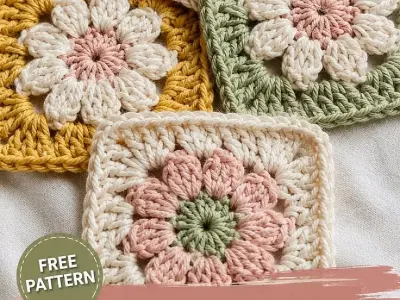
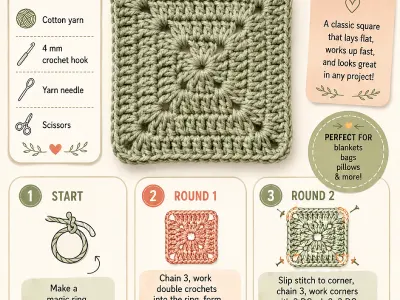
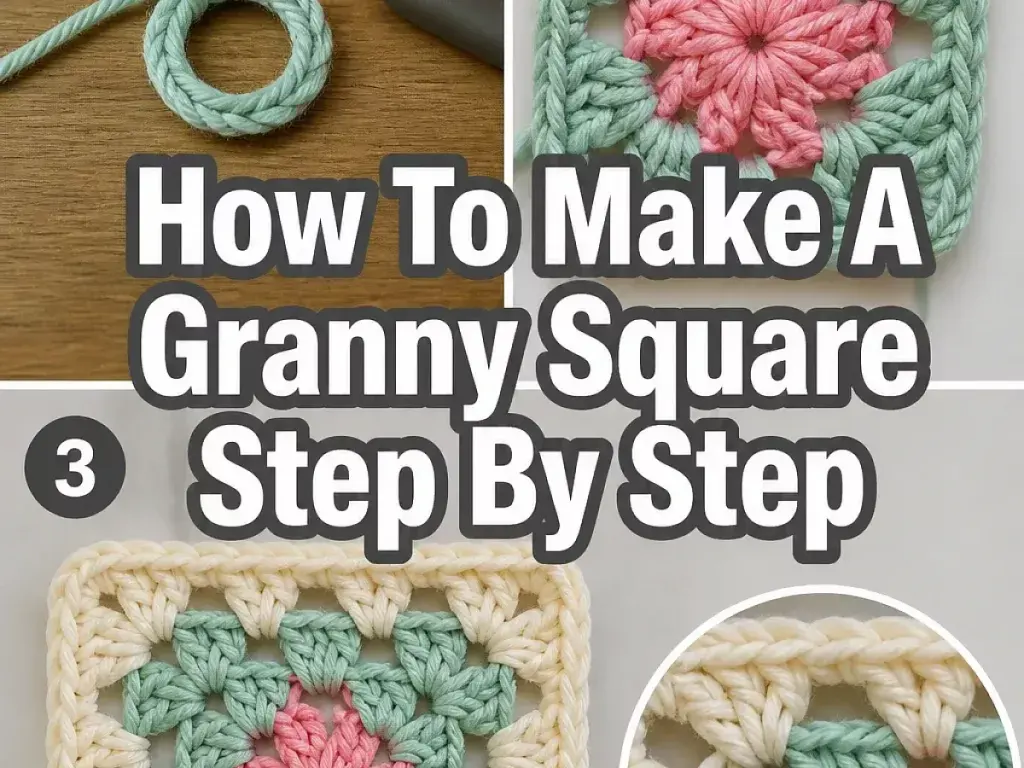
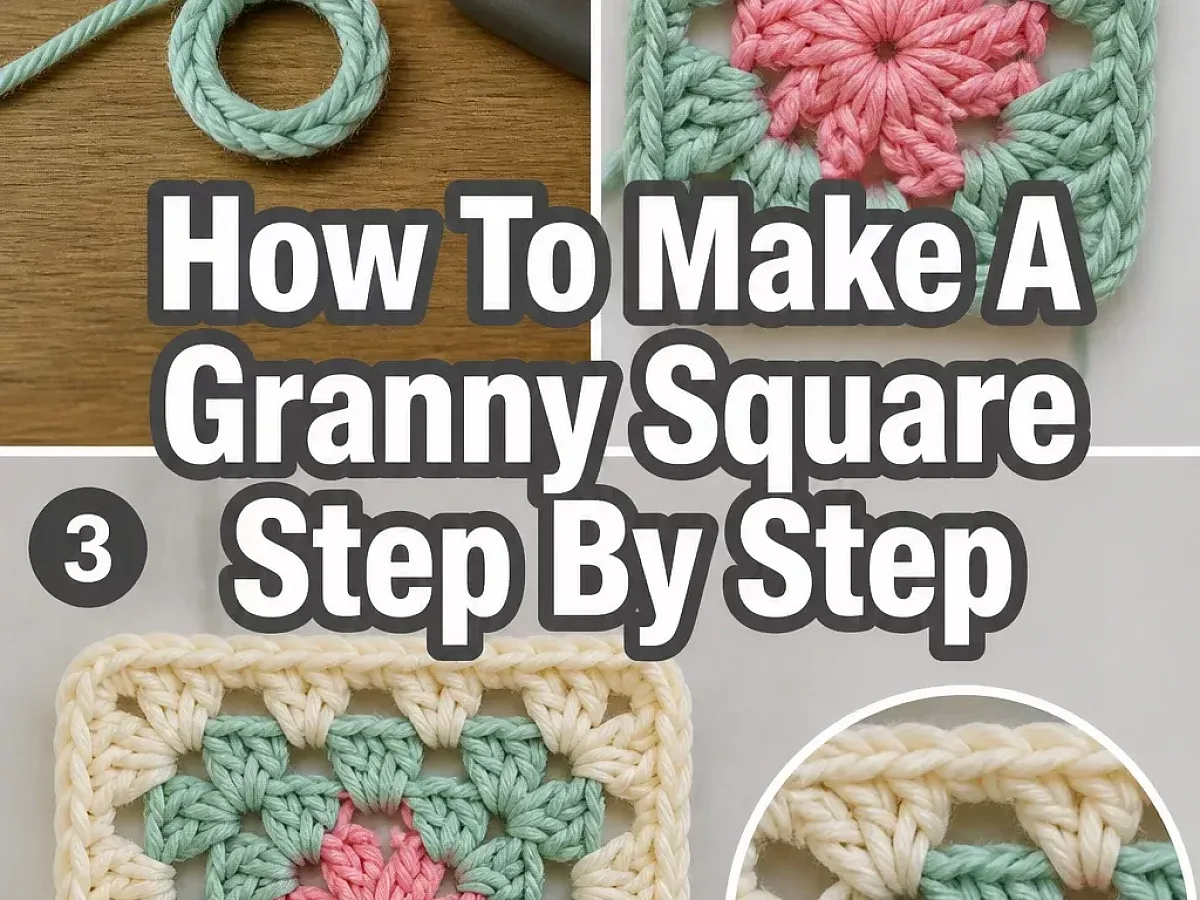
Each photo in the collage shows one stage: the chain ring, round one clusters, the corner turns, and the final round. Match your work to the frame before you move on. A standard square is four rounds, about 4 inches across, in double crochet clusters of three.
What you need
Worsted weight yarn
One skein of about 170 yards makes roughly 14 squares. Cotton shows stitches clearly; acrylic is softer and cheaper.
5 mm (H-8) hook
Go up to 5.5 mm if your squares come out under 4 inches. Go down to 4.5 mm if they come out over.
Tapestry needle
A blunt needle with an eye wide enough for worsted yarn, for weaving in the 6-inch tails.
Stitch marker
One marker in the corner chain space saves you from recounting. A paper clip works.
Tape measure
Any soft tape. You only need to check the 4-inch finished size once per hook change.
What the collage frames are actually showing
Most granny square collages follow the same order. Frame one is the slip knot and a ring of four to six chains joined with a slip stitch. Frame two is the first cluster of three double crochets worked into that ring.
The middle frames show corners. Every corner is the same shape: three double crochets, two chains, three double crochets, all in one chain space. If a frame in your collage shows a cluster with no chain gap beside it, that is a side, not a corner.
The last frame is the finished square, usually four rounds and roughly 4 inches wide in worsted weight yarn. Count the clusters along one edge to check which round you are looking at.
- Round 1: four clusters of three double crochets, separated by two chains
- Round 2: eight clusters, one corner chain space between each pair
- Round 3: twelve clusters
- Round 4: sixteen clusters, with a 2-inch gap at each corner
If the collage has no numbers, count clusters on the outer edge of each frame. The count tells you the round faster than the picture does.
Yarn, hook, and the numbers that matter
Use worsted weight yarn, the common category 4 skein, with a 5 mm (H-8) hook. That pairing gives a square about 4 inches across after four rounds.
Gauge is loose here, but it still matters if you plan to join squares into a blanket. Work one square, measure it flat, and adjust your hook rather than your hands. A 5.5 mm hook adds roughly a quarter inch to the finished square.
You need about 10 to 12 yards of yarn per square in worsted weight. A 170-yard skein gives you around 14 squares, which is a useful number to know before you commit to a blanket.
Cotton yarn shows stitch definition better in photos and in your own work. Acrylic is cheaper and softer for blankets. Either works.
Abbreviations used in every granny square collage
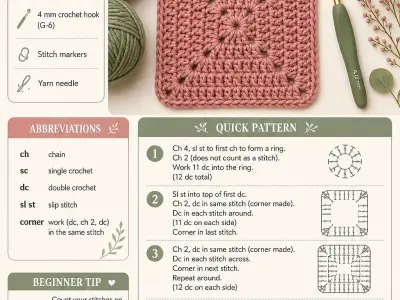
The collage text uses short forms. Learn these six and the pattern stops looking like code.
- ch: chain
- dc: double crochet (US term)
- sl st: slip stitch
- sp: space
- cl: cluster, meaning three double crochets worked together
- beg: beginning
UK patterns call the same stitch a treble. If your collage says tr, work a double crochet the US way.
Working the square, frame by frame
Follow the collage in order and check your work against each frame before moving on. The whole square takes about 8 to 10 minutes once you know the rhythm.
Keep the collage open beside you rather than scrolling back and forth. Print it or pin it where your eyes already rest.
Where the square goes wrong, and how to fix it
The most common error is putting the corner cluster in the wrong space. If your square turns into a circle or a wobbly pentagon, you worked two clusters into one chain space or skipped a space entirely. Undo back to the last round and count the spaces out loud.
The second error is a tight starting ring. If the first round of clusters will not sit flat, your chain ring is too small. Try six chains instead of four, or start with a magic ring.
The third is uneven tension between clusters. Corners pull in and the square looks like a star. Go up one hook size for the next square and compare the two side by side.
- Wavy edge: too many stitches per side, recount clusters
- Cupping bowl shape: too few stitches, or a tight ring
- Hole at the start: the ring was not closed with a slip stitch
Lay each round flat on a table before starting the next one. A square that will not lie flat now will not lie flat after blocking.
Finishing and joining squares
Cut the yarn leaving a 6-inch tail and pull it through the loop. Weave the tail into the back of the square for about 2 inches, going through the middle of the stitches, not around them.
Block the square by misting it lightly and pinning it to a towel or board at 4 inches square. Let it dry flat. Blocked squares join more evenly and the blanket edge stays straighter.
To join, hold two squares right sides together and slip stitch or single crochet through both layers along one edge. Join in strips first, then join the strips. That order keeps the weight manageable.
Skip blocking if the squares are for a toy or a bag. Block anything that will be washed and worn.
Step
Make the ring
Chain four and join with a slip stitch, or make a magic ring. The ring should sit flat and open enough to fit your hook through twice.
Round 1
Chain three, then work three double crochets into the ring. Chain two, then repeat three more times. Join with a slip stitch to the top of the starting chain. You should have four clusters and four chain spaces.
Round 2
Slip stitch into the nearest corner space. Chain three, work two double crochets, chain two, then three double crochets in the same space. Repeat in each corner space. Join. Eight clusters now sit around the square.
Round 3
Work a corner of three double crochets, two chains, three double crochets in each corner space. Work three double crochets in each side space between corners. Join. Twelve clusters total.
Round 4 and finish
Repeat the round 3 rhythm once more. Join, cut the yarn with a 6-inch tail, and weave the tail into the back. Lay the square flat and measure it.
Ways to change it
Change the color each round
Join a new color at each corner. Cut and weave tails as you go so the back stays tidy.
Solid square, no gaps
Work one chain at each corner instead of two. The square gets denser and suits potholders.
Bigger square
Keep adding rounds. Each round adds about half an inch and sixteen more clusters.
Cotton for dishcloths
Cotton holds up to hot water better than acrylic. Use the same 5 mm hook and expect a slightly firmer square.
Scrap yarn version
Use any leftover worsted yarn. Squares come out slightly different sizes, so block them all to 4 inches before joining.
The short version
- A standard granny square is four rounds and about 4 inches across in worsted weight yarn on a 5 mm hook.
- Every corner is three double crochets, two chains, three double crochets in one chain space.
- Cluster counts per round go four, eight, twelve, sixteen.
- One square uses 10 to 12 yards of yarn and takes about 8 to 10 minutes.
- A wavy square means too many stitches; a cupped square means too few.
- Block squares to 4 inches before joining so seams stay straight.
Questions people ask
How many chains do you start a granny square with?
Four chains joined into a ring is the standard start. Use six if your first round pulls tight. A magic ring also works and closes the center hole completely.
What size hook do you use for a granny square?
A 5 mm (H-8) hook with worsted weight yarn gives a 4-inch square in four rounds. Adjust up or down one size to hit that measurement.
How much yarn does one granny square take?
About 10 to 12 yards of worsted weight yarn per four-round square. That works out to roughly 14 squares from a 170-yard skein.
Why is my granny square not square?
Usually the corner clusters landed in the wrong chain space, or a side space was skipped. Count the chain spaces at the end of each round and undo back to the last correct round.
Can you make a granny square without a pattern?
Yes. Once you know the corner rule, three double crochets, two chains, three double crochets, you can keep adding rounds from memory. The collage frames will make sense without any written text.
Pick one frame and work that round today
Print the collage, keep it beside your hook, and check each round against its frame before starting the next. One square first. Then decide about the blanket. Close tabs, start small.