Table of Contents
- Crochet Tutorial Graphic with a Green Granny Square: How to Read It and Make One
- What you need
- What the graphic is actually showing you
- Yarn, hook and the numbers that matter
- Abbreviations on the graphic
- Working the four rounds in order
- Joining and finishing
- When it goes wrong
- Step
- Ways to change it
- The short version
- Questions people ask
- You might also like
Crochet Tutorial Graphic with a Green Granny Square: How to Read It and Make One
Read the graphic, pick your green, and finish a flat square in about twenty minutes.
A green granny square is the friendliest thing you can crochet: one hook, one colour, and four rounds that turn a slip knot into a flat 10 cm square.
Granny squares look complicated on paper. They aren't. The whole thing is chains, double crochet, and one repeated corner move that you'll have memorised by round three.
The green in the picture matters more than you'd think. A mid-tone green shows the stitch definition clearly, so you can see where each cluster starts and ends. Pale mint and dark forest both hide that detail.
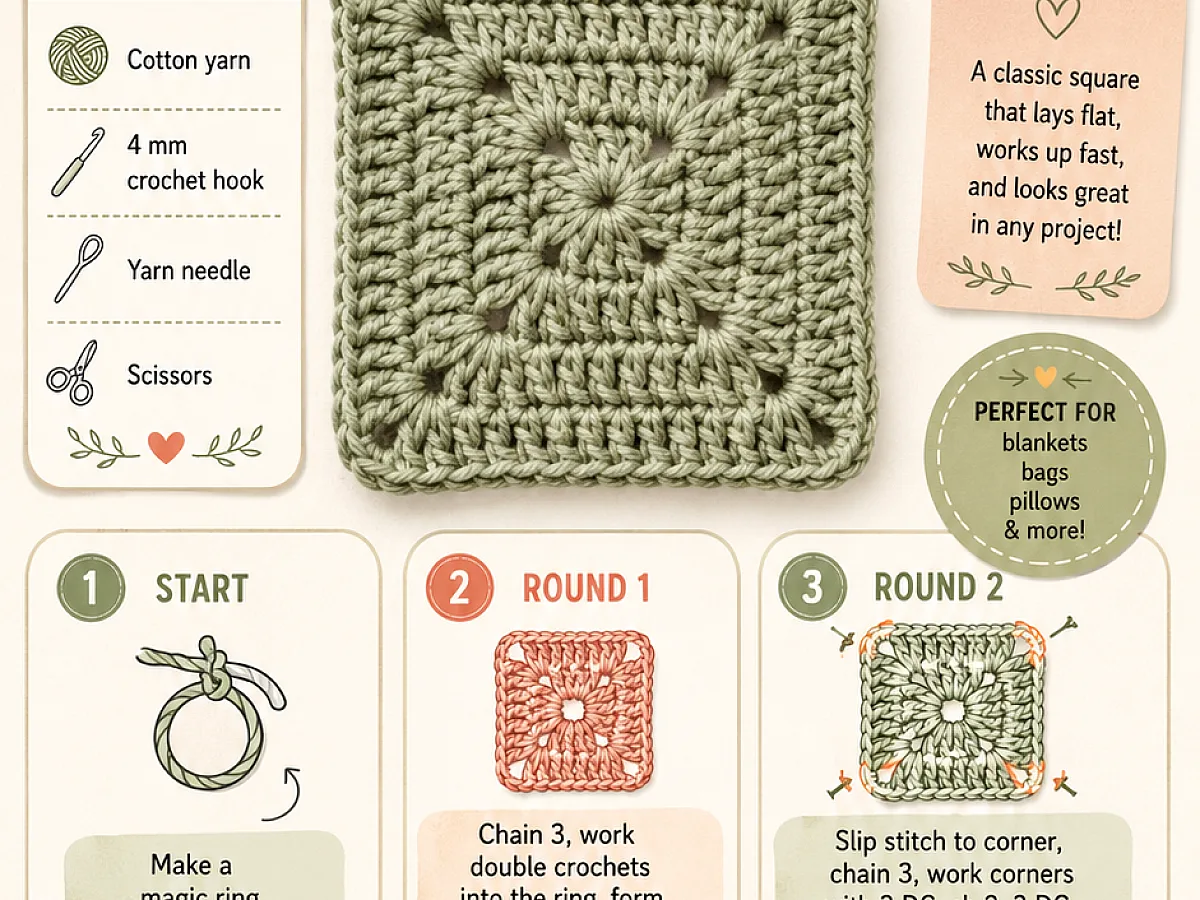
A standard granny square is four rounds of double crochet clusters worked into corner chain spaces, and it measures roughly 10 cm across in DK yarn with a 4 mm hook. The graphic walks you through those rounds in order, with the stitch counts printed beside each one.
What you need
DK weight yarn in green
One 100 g ball makes about five squares. Acrylic is cheap and washable; cotton gives crisper corners but less stretch.
4 mm crochet hook
Aluminium or ergonomic handle, whichever feels comfortable. A 4.5 mm hook works if your tension is tight.
Blunt tapestry needle
For weaving in ends. A sharp needle splits the yarn and leaves fuzz.
Small scissors
Any pair will do. Keep them with your project so you don't hunt for them mid-round.
What the graphic is actually showing you
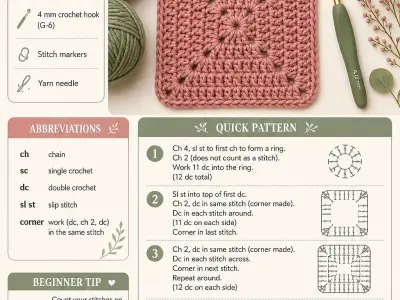
A tutorial graphic is a pattern drawn as a picture. Instead of rows of text, you get the square in the middle and short written instructions around the edge, usually numbered one to four.
Read it in a circle, not top to bottom. Round one sits at the centre, round four is the outer edge. If the numbers run clockwise, that's the direction you crochet.
The tiny chain symbols between clusters are corner spaces. Those are the gaps your hook goes into on the next round, and missing one is the single most common reason a square goes lopsided.
If the text on the graphic is too small to read on your phone, screenshot it and zoom in. Most phones will sharpen the letters as you enlarge.
Yarn, hook and the numbers that matter
Use DK weight yarn, sometimes sold as light worsted or 8-ply, with a 4 mm hook. That combination gives a square of about 10 cm after four rounds.
Gauge isn't critical for a single square. It becomes critical the moment you join squares together, because two squares of different sizes will not sit flat next to each other.
Check your first square against a ruler before you make twenty more. If it measures 9 cm, go up half a hook size. If it measures 11 cm, go down half a size.
- Yarn weight: DK, roughly 15 to 20 g per square
- Hook: 4 mm, or whatever gives you 10 cm
- Stitch count after round four: four clusters per side, four corner spaces
- Finished size: about 10 cm by 10 cm
Weigh your yarn before you start a big blanket. One square uses around 18 g, so a 100 g ball gives you five squares with a little spare.
Abbreviations on the graphic
Granny square graphics use the same short forms as written patterns. Learn six and you can read almost any of them.
UK and US terms differ, and this trips up more people than any stitch does. A US double crochet is a UK treble. Check which system the graphic uses before you pick up the hook.
- ch: chain
- dc: double crochet (US) or treble (UK)
- sl st: slip stitch
- sp: space
- beg: beginning
- rep: repeat
Working the four rounds in order
Each round ends with a slip stitch into the top of the starting chain. That join is what keeps the square square.
Don't turn your work between rounds. A granny square is worked in the round from one side, and turning it makes the corners twist.
Count your clusters out loud at the end of every round. Four per side, plus the corners. If you have five on one side, you've worked into a chain instead of a space.
Joining and finishing
Fasten off by cutting the yarn about 10 cm from the last stitch, pulling it through the loop, and threading the tail onto a blunt needle. Weave it through the back of three or four stitches, then back the other way.
Two passes in opposite directions stop the tail working loose in the wash. A single pass will not hold through a machine cycle.
Join squares with a slip stitch through the back loops only, or a single crochet seam. Slip stitch gives a flatter join; single crochet gives a visible ridge that some people like.
When it goes wrong
A square that cups upward has too many stitches. A square that ripples at the edges has too few. Both are fixable: pull back one round and recount.
If your corners look rounded instead of pointed, you've probably put two clusters in the corner space instead of the correct three-chain, cluster, three-chain combination.
Green yarn shows mistakes less than white but more than black. If you're learning, use the green. You'll see the problem without unpicking your confidence.
Keep your first square, even the ugly one. In six months it's the best record you'll have of how far your tension has come.
Step
Make a slip knot and chain four
Join with a slip stitch to form a ring. Give the ring a gentle tug; it should close without a gap in the middle.
Round one: four clusters
Chain three, then work three double crochet into the ring. Chain two, then three double crochet again. Repeat until you have four groups, then join. You should see a small square with four corner gaps.
Round two: work into the corners
Slip stitch across to the first corner space. Work three double crochet, chain two, three double crochet into that space. Repeat in each of the other three corners and join. The square should now be visibly bigger and still flat.
Rounds three and four: same move, more spaces
Each round adds one cluster group per side. Work into every chain space along the sides and the corner combination into every corner. Lay it flat after each round to check it hasn't cupped.
Fasten off and weave in
Cut the yarn, pull the tail through, and thread it onto a blunt needle. Weave through four stitches one way, then four the other way, and trim.
Ways to change it
Two-colour square
Work rounds one and two in green, rounds three and four in cream. Uses up odds and ends and makes the pattern easier to read.
Cotton for potholders
Swap acrylic for worsted cotton and drop to a 3.5 mm hook. The fabric gets denser and handles heat better.
Chunky version
Bulky yarn with a 6 mm hook gives a 15 cm square in three rounds. Good for a quick cushion cover.
Solid square
Work clusters into every stitch instead of every space. No gaps, warmer, and slower to make.
Scrap blanket
Keep every green you own and make one square per shade. Twenty-five squares gives a pram blanket of roughly 50 cm.
The short version
- A standard granny square is four rounds and measures about 10 cm in DK yarn with a 4 mm hook.
- Read the graphic in a circle from the centre outward, not top to bottom.
- US double crochet and UK treble are the same stitch, so check which the graphic uses.
- Cupping means too many stitches; rippling means too few.
- Weave tails in two directions or they work loose in the wash.
- One 100 g ball of DK makes about five squares.
Questions people ask
How much yarn does one granny square use?
About 18 g of DK weight yarn for a 10 cm square. A standard 100 g ball gives you five squares with a small amount left over.
Why is my granny square not square?
Usually the corner spaces are uneven. Count three chains in every corner and make sure you work into the space, not into the stitches beside it.
Do I turn my work between rounds?
No. Granny squares are worked from one side only. Turning twists the corners and makes the join line wander.
Can I use a bigger hook with the same yarn?
Yes, but the square gets bigger and looser. If you plan to join squares, keep every square on the same hook size or they won't line up.
What's the difference between US and UK double crochet?
A US double crochet is a UK treble. The names shift by one step, so always check which system the graphic follows before you start.
Pick your green and work the first round
The first square takes twenty minutes and the second takes ten. Once your hands know the corner move, the graphic becomes a reminder rather than a set of instructions. Taste, adjust, enjoy.