Table of Contents
- Solid Granny Square Crochet Pattern: Materials, Abbreviations and Steps
- What you need
- What makes a granny square solid
- Materials and abbreviations
- Gauge and finished size
- The pattern, round by round
- Joining and finishing
- When it goes wrong
- Step
- Ways to change it
- The short version
- Questions people ask
- You might also like
Solid Granny Square Crochet Pattern: Materials, Abbreviations and Steps
Work a solid granny square from a magic ring to a flat four-round block, with the yarn, hook and stitch counts written out.
A solid granny square has no gaps in the middle, and that is the whole point: you fill the corners with double crochet clusters instead of chain spaces.
Most granny squares show daylight through them. A solid one does not, which is why it suits blankets, bags and cushion fronts where you want warmth and a clean surface.
The difference is small and it is all in the corners. Once you see it, you will not go back to the open version for anything that needs to hold its shape.
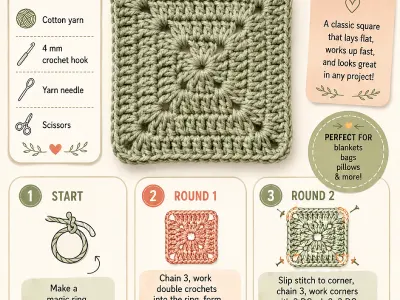
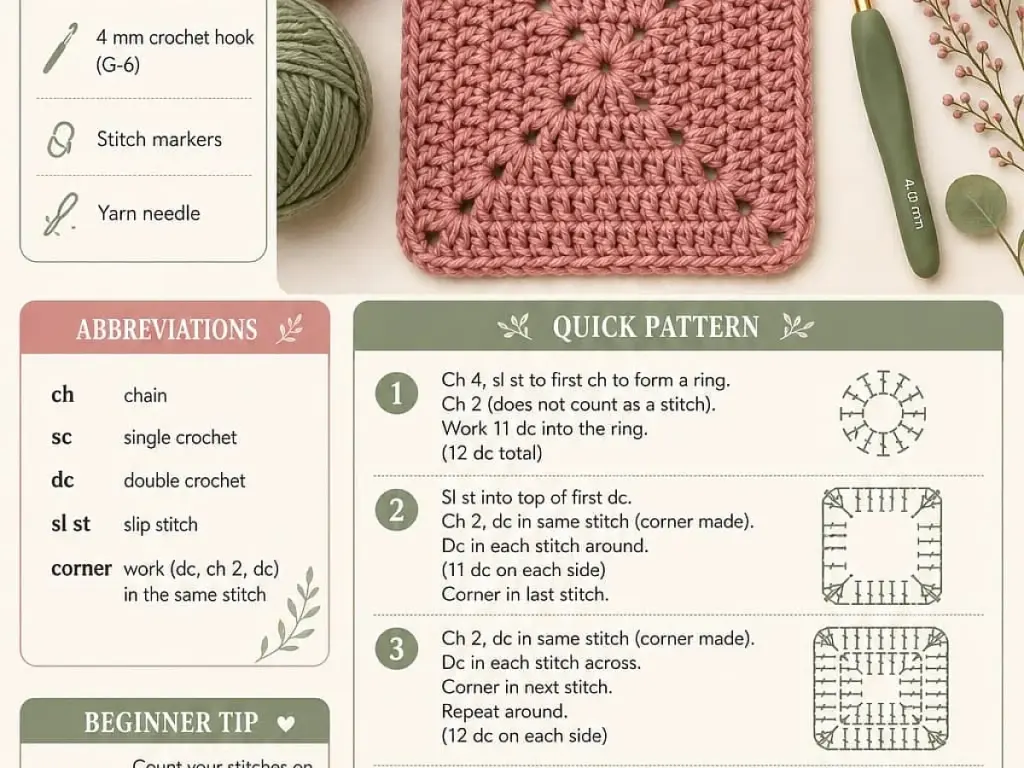
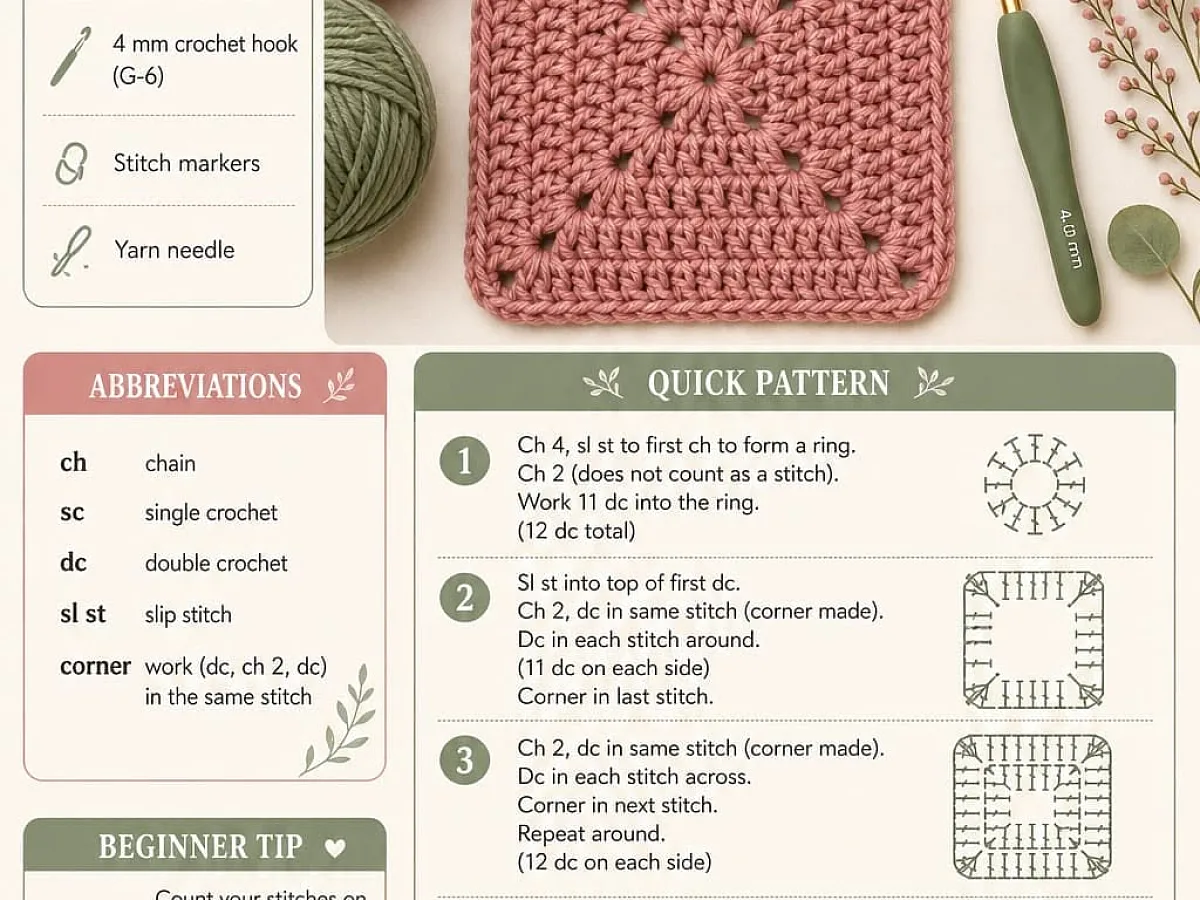
You need about 15 g of worsted weight cotton and a 4 mm hook. Four rounds give you a square roughly 10 cm across. The pattern is double crochet, chain, and slip stitch, worked from the center out.
What you need
Worsted weight cotton yarn
One 50 g ball makes about three squares. Style Cotton or any category 4 cotton works. Avoid fluffy yarn, which hides the corner clusters.
4 mm crochet hook
A G-6 hook. Use 4.5 mm if your tension runs tight, 3.5 mm if your squares come out over 11 cm.
Tapestry needle
Blunt tip, large eye. Needed for the two tails on every square.
Scissors
Any small pair. Keep them with the project so you do not stop mid-round.
Stitch marker
One marker, or a scrap of contrasting yarn. Marks the first stitch of each round so the count stays honest.
What makes a granny square solid
A standard granny square works a chain space at each corner. Those spaces stack up round after round and leave four thin lines of holes.
A solid square replaces the corner chain with a tight cluster: two double crochet, one chain, two double crochet in the same corner stitch. The corner still turns. It just does not gape.
The center matters too. A magic ring pulls shut with no hole at all. A chain-four ring leaves a small opening you can close later with a yarn tail, which is fine but slower.
Squash the square flat on the table after round two. If the center bulges up, your starting ring was too tight and the whole block will stay cupped.
Materials and abbreviations
Worsted weight cotton is the safe choice. Acrylic works but it stretches at the corners after a few washes, so keep it for practice squares.
One 50 g ball of worsted cotton makes roughly three 10 cm squares. Buy two balls if you plan a cushion front.
- Yarn: worsted weight (category 4) cotton, about 15 g per square
- Hook: 4 mm (G-6), or 4.5 mm if you crochet tightly
- Tapestry needle for weaving in two tails
- Scissors
- Stitch marker, optional, for the first stitch of each round
Abbreviations used here: ch (chain), sl st (slip stitch), dc (double crochet), st (stitch), sp (space), rep (repeat). US terms throughout. UK readers: read dc as tr.
Gauge and finished size
Work four rounds, then measure. A square should come out at 10 cm by 10 cm. If yours is 9 cm, go up one hook size. If it is 11.5 cm, go down.
Gauge matters here because squares get joined. Twenty squares at 9 cm give you a 45 cm wide blanket panel. At 11 cm the same twenty give 55 cm, and nothing lines up with your plan.
Stitch count per side after round four: 13 double crochet plus the corner chain. Count one side before you join anything.
The pattern, round by round
Each round is worked in one direction and closed with a slip stitch. Turn only if you want a reversible square with no visible seam.
Keep the corner chain to one stitch. Two chains make a rounded, floppy corner that will not sit flat when joined.
Joining and finishing
Weave the starting tail into the back of the center for 3 cm, then trim. Do the same with the ending tail along a row of stitches, not straight across the corner.
To join squares, hold them wrong sides together and slip stitch through both loops along one side. That gives a flat seam with almost no bulk.
Block finished squares by misting them and pinning to 10 cm. Cotton holds the shape once dry, about four hours at room temperature.
When it goes wrong
The square curls into a bowl. Usually too many stitches in the corners. Recount: each corner gets two dc, one ch, two dc, and nothing more.
The sides wave. That is too few stitches along the straight edge, or a hook too large for the yarn. Try a 3.5 mm hook with the same yarn.
The center has a hole. Your magic ring loosened. Pull the tail again while the first round is still on the hook, before round two locks it.
One side is longer than the other. You probably added a stitch where the round began. Mark the first stitch of each round and count at the end.
Step
Make a magic ring
Wrap the yarn twice around two fingers, pull a loop through, and work 3 ch. Hold the tail firmly. The ring should close to nothing when you pull it.
Round 1: the center
Work 2 dc into the ring, then 1 ch. Repeat that pair three more times, then join with a sl st to the top of the first 3 ch. You now have four corner spaces and 8 dc. Pull the tail tight and check the hole is closed.
Round 2: first full corner round
Sl st into the next corner space. Work 2 dc, 1 ch, 2 dc into that space. Then 1 dc into each of the next 2 st, and repeat the corner into the next space. Four corners, 16 dc total. The square should already look square, not round.
Round 3: sides grow
Sl st to the next corner. Work the corner cluster, then 1 dc into each stitch along the side, then the next corner. You should count 5 dc between corners on each side. Press the piece flat with your hand before round four.
Round 4: final size
Repeat the same logic: corner cluster, then 1 dc in every stitch along the side, ending with a sl st join. Count 9 dc between corners per side. Measure across the middle. It should read 10 cm.
Finish and weave in
Cut the yarn leaving a 10 cm tail. Pull it through the last loop. Thread both tails onto the tapestry needle and run each one 3 cm along the back of the work, changing direction once so it cannot work loose.
Ways to change it
Five-round square
Add one more round of dc along the sides. Gives a 12 cm square, good for a lap blanket where 10 cm squares mean too many joins.
Two-color square
Change color after round two. Carry the old color up the back rather than cutting, which saves two tails per square.
Cotton for potholders
Work two squares and join them back to back with single crochet. Use cotton only, never acrylic, which melts against a hot pan.
Chunky version
Bulky yarn with a 6 mm hook makes an 18 cm square in four rounds. One evening gives you a cushion front.
Left-handed adjustment
Work the same rounds in the opposite direction. The corner clusters are identical, so nothing in the pattern changes.
The short version
- A solid granny square uses a corner cluster of 2 dc, 1 ch, 2 dc instead of an open chain space.
- Four rounds with worsted cotton and a 4 mm hook give a 10 cm square.
- One 50 g ball makes about three squares at 15 g each.
- Count 9 dc between corners after round four to check the size.
- Curling corners almost always mean extra stitches in the corner cluster.
- Blocking to 10 cm with water and pins sets cotton squares flat before joining.
Questions people ask
How much yarn does one solid granny square use?
About 15 g of worsted weight cotton, which is roughly a third of a 50 g ball. A 10 cm square in double crochet uses very little yarn, so leftovers are enough.
Can I use acrylic yarn instead of cotton?
Yes, and it is cheaper for practice. Acrylic stretches at the corners after washing, so keep cotton for anything that needs to hold a flat shape, like a bag or potholder.
Why is my solid granny square not square?
Usually a stitch count problem. Count the double crochet between two corners after round four. You should have 9. If one side has 8, the block pulls into a trapezoid.
Do I need to block granny squares before joining?
Not always, but cotton squares join more evenly when blocked. Mist them, pin to 10 cm, and leave about four hours. Acrylic needs steam instead of water.
What is the difference between a solid granny square and a regular one?
The corner. A regular square works a chain space at each corner, which leaves visible holes. A solid square fills that space with two double crochet on each side of a single chain.
Gather your yarn and work the first round tonight
Work one square all the way to the end before you start a second. Measure it, block it, and only then decide your hook size for the rest. Ten minutes of checking now saves you from unpicking twenty squares later. Close tabs, start small.