Table of Contents
- Why Procrastination Deserves a Gentler Conversation
- Distinguishing Faith-Based Productivity from Worldly Hustle
- Biblical Anchors for Overcoming Delay
- Practical Steps to Move Forward with Clarity
- Creating a God-Centered Goal Setting Rhythm
- Gentle Encouragement for Students and Weary Hearts
- Discipline as an Act of Self-Love and Obedience
- FAQ
We’ve all been there. You stare at the task list, feel a wave of resistance, and suddenly reorganizing the spice drawer becomes urgent. Procrastination isn’t just a time management problem—it often carries a spiritual weight. That gentle nudge toward delay can be laced with fear, perfectionism, or a quiet doubt that you’re equipped for what you’ve been called to do. A faith-based approach to productivity doesn’t shame you out of procrastination. It invites you to understand what’s underneath the pause and to exchange that frozen feeling for purpose, peace, and grounded progress. This is about learning to move forward not from pressure, but from a place of trust.
Why Procrastination Deserves a Gentler Conversation
Procrastination is rarely pure laziness. More often, it’s a signal. It can be a fear of failure wearing a disguise, an overwhelm response when a task feels too large, or a quiet perfectionism that says, “If I can’t do it perfectly, I shouldn’t start.” For believers, there is sometimes an added layer. You might feel paralyzed because you aren’t sure if a project is part of God’s will, or you might be waiting for a clear sign before making the first imperfect move. Faith-based productivity doesn’t start with a rigid system. It starts by gently asking, “What story am I telling myself about this task, and is that story true?”
When we ignore these internal cues and push harder, we often burn out. When we name the root—fear, confusion, exhaustion—we can address it with both practical tools and spiritual truth. Scripture consistently meets us in our hesitation. The Bible does not present a God who wants us crushed under heavy loads of anxious productivity. It presents a God who gives strength, wisdom, and even rest as a command. Facing procrastination with faith means acknowledging your limits while trusting God’s provision for the work at hand.
Distinguishing Faith-Based Productivity from Worldly Hustle
Secular productivity often orbits around maximizing output, optimizing every hour, and treating rest as a strategic recovery tool for more work. God-centered goal setting flips this. It begins with identity, not achievement. You are not a machine whose value is measured by completed checkboxes. You are a created person with finite energy, a mind that needs renewal, and a spirit that needs connection as much as accomplishment. Faith-based motivation isn’t about doing more things faster. It’s about stewarding your time and talents in a way that aligns with your God-given purpose and preserves your peace.
This shift matters because it breaks the cycle of guilt-driven work. When you believe your worth is tied to output, any delay feels like a moral failure. When you understand that you work from a place of already being loved and accepted, discipline becomes an act of worship rather than a frantic attempt to prove your value. Practical steps and Bible verses work together here: principles like starting small and setting priorities give you a manageable path, while scripture roots your motivation in eternal significance rather than fleeting applause.
Biblical Anchors for Overcoming Delay
Scripture is rich with encouragement for the procrastinating heart. Rather than a harsh command to simply “do better,” the Bible offers wisdom, presence, and a reframing of work itself. Meditating on these truths can gently loosen the grip of paralyzing thoughts and replace them with anchored, peaceful action.
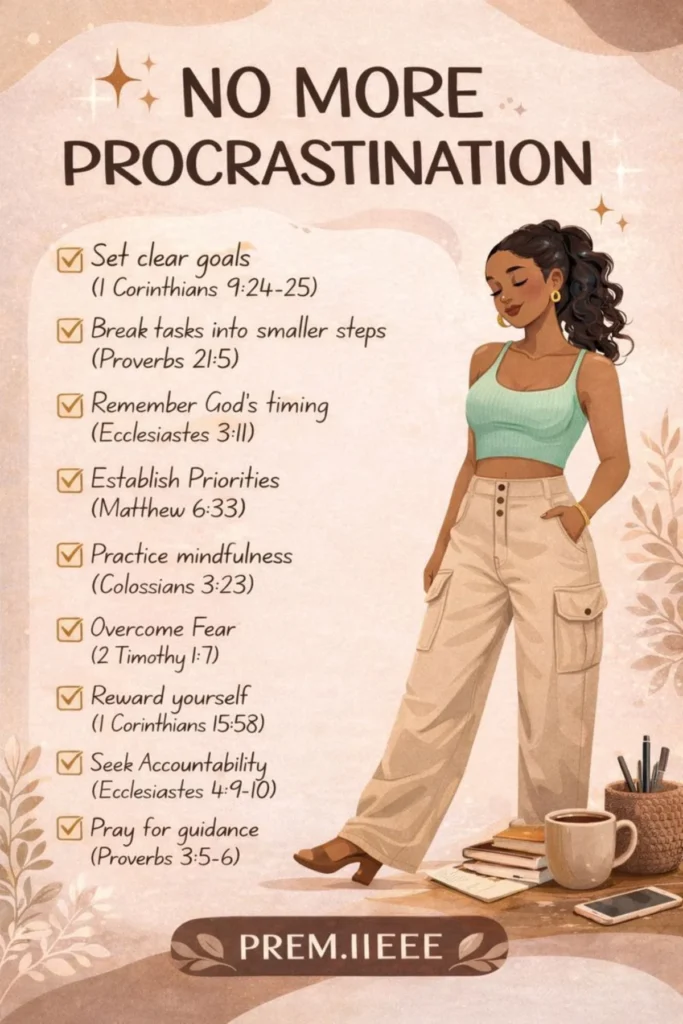
- Proverbs 16:3: “Commit to the Lord whatever you do, and he will establish your plans.” Before making a to-do list, prayerfully surrender each major task. This practice shifts the weight from your shoulders to God’s guidance.
- Colossians 3:23: “Whatever you do, work at it with all your heart, as working for the Lord, not for human masters.” This reframes even mundane tasks as meaningful. You’re not just answering emails or studying; you’re serving with purpose.
- 2 Timothy 1:7: “For God has not given us a spirit of fear, but of power and of love and of a sound mind.” Procrastination rooted in anxiety can be met with this promise of a sound, disciplined mind.
- Philippians 4:13: “I can do all this through him who gives me strength.” Not strength for everything imaginable, but for what God calls you to specifically—step by step.
- Psalm 90:17: “May the favor of the Lord our God rest on us; establish the work of our hands for us—indeed, establish the work of our hands.” A prayer for meaningful work and tangible progress.
Practical Steps to Move Forward with Clarity
Bridging the gap between spiritual truth and daily action makes faith practical. When you feel stuck, having a gentle, repeatable process helps you obey the nudge to start without waiting for a surge of motivation. These steps work with your brain’s natural wiring and your spirit’s need for grace.
- Name the resistance. Spend two quiet minutes asking why you’re avoiding something. Is it fear, lack of clarity, or simple fatigue? Write it down honestly. Naming what’s wrong often shrinks its power.
- Pray and release perfectionism. Offer the task to God with a simple prayer: “I give this to You. Help me begin imperfectly.” Starting badly is infinitely better than not starting, and you can improve as you go.
- Identify the smallest next action. Don’t list five huge goals. Ask what single small step you can take in the next fifteen minutes. A phone call, an outline, a cleaned workspace—one clear action reduces overwhelm.
- Set a gentle timer. Commit to just fifteen or twenty minutes of focused work, followed by a break. Short focused bursts honor your need for rhythm and prevent burnout. Often, starting is the hardest part.
- Review with grace, not judgment. At day’s end, don’t tally failures. Notice what you did accomplish, thank God for strength, and adjust tomorrow with kindness. This builds momentum over time without the weight of shame.
Creating a God-Centered Goal Setting Rhythm
Long-term change comes from sustainable rhythms, not dramatic overhauls. Weekly or monthly planning that includes prayer and reflection turns goal setting into a spiritual practice. This isn’t about mapping every moment. It’s about discerning what is truly yours to carry and laying aside the rest. Structure without burnout grows from knowing your limits and respecting seasons of life.
Try a Sunday evening or Monday morning practice. Light a candle, open your Bible, and review the upcoming week. Write down three priorities that align with your values and current responsibilities. For each priority, attach a simple actionable step. Ask God for wisdom to say no to additional commitments that would steal your peace. When unexpected demands arise, you already have a framework to test whether they fit. This habit keeps you focused on purpose-driven progress, not reactive busyness.
Gentle Encouragement for Students and Weary Hearts
Students face unique pressure. Deadlines, exams, and big dreams can tangle together into a heavy knot. Christian women balancing work, family, and service often feel pulled in multiple directions, exhausted before the day fully begins. If this is you, please hear this: you are allowed to rest. Productivity influenced by faith does not ignore human limits. Jesus himself withdrew to quiet places. He slept in a boat during a storm. Rest is both a physical need and a declaration of trust that you are not the one holding the world together.
When a study session feels impossible, try a short devotional pause. Read a calming psalm, breathe, and then set a timer for focused work. Keep study spaces simple and distraction-free. If your heart is heavy or your body is depleted, prioritize care. True discipline sometimes looks like saying no to late-night cramming in favor of sleep, trusting God with the outcome. A clear well-rested mind absorbs and creates far better than one running on fumes.
Discipline as an Act of Self-Love and Obedience
Biblical discipline is not punishment. It’s training. It’s the same root as the word “disciple.” When you practice small consistent acts of discipline, you are training your heart and mind to follow through on commitments. This builds integrity and self-respect. It also opens space for God to work through your faithful action. You don’t have to feel ready. You just have to be willing.
Pairing spiritual practices with practical scheduling creates a powerful framework. Place prayer breaks as real blocks in your calendar. Silence notifications during focused times so you can be present with the work God has given you. When you inevitably fall off track, resist the pull of harsh self-criticism. You are not starting over from scratch. You are continuing with greater wisdom. Every day offers fresh mercies and renewed opportunities to walk forward with purpose.
FAQ
Is procrastination always a result of poor time management?
Not usually. Procrastination is often an emotional response. It can be triggered by fear of not doing a task well, overwhelm from a large project, unclear priorities, or physical exhaustion. In a faith context, it might also be rooted in spiritual uncertainty. Instead of reaching first for a stricter schedule, gently explore what emotion or belief is causing you to pull back. Addressing the root makes practical strategies far more effective.
How can I tell if I’m resting wisely or just avoiding hard work?
Wise rest renews you and leaves you feeling more able to engage with life afterward. Avoidance often makes the task loom larger in your mind and creates guilt that lingers. A helpful question to ask is: “After this break, will I feel refueled or more anxious?” If it’s the latter, you might be avoiding something. Setting a timer for a reasonable rest period and then taking one small action afterward can help you discern the difference without harshness.
What if I don’t feel motivated even after praying?
Motivation often follows action, not the other way around. It’s common to still feel resistant after prayer. In these moments, view the act of starting as an act of faith. You’re moving your body and mind in obedience, trusting that the feeling of motivation may catch up later. Pray for strength, then commit to the smallest possible step. God’s provision often looks like enough grace for the next five minutes, not an overwhelming emotional surge.
Can a faith-based approach to productivity actually reduce burnout?
Absolutely. Secular approaches sometimes treat personal capacity as an obstacle to overcome through efficiency. Faith-based productivity respects limits as God-given. It builds a rhythm of work and rest that honors scripture, reminds you your worth is not in your output, and encourages surrender of outcomes. When you stop trying to function as if everything depends on you alone, you lower the chronic stress that leads to burnout. You work hard from a place of peace, then you rest with a clear conscience.
How do I handle big goals without getting overwhelmed?
Break every big goal into projects, and projects into small specific tasks. Then, bring each piece before God in prayer. Instead of aiming for “complete degree” or “grow a ministry,” focus on the next faithful step: reading one chapter, making one supportive call, writing one paragraph. God-centered goal setting pays attention to seasons and current capacity while trusting that small consistent steps add up over time. Progress is still progress, no matter how gentle.
Walking away from procrastination does not mean turning into a rigid productivity machine. It means moving forward with greater wholeness, holding practical tools in one hand and deep trust in the other. You do not need to conquer your entire to-do list today. You only need to take the next step that is yours to take, supported by prayer and sustained by grace. May you find relief from guilt, clarity in your calling, and the gentle courage to begin. Purpose, peace, and progress are already within reach, and you don’t have to strive for them alone.