Table of Contents
- 22 Emergency Bible Verses to Keep Close
- When You Feel Emotionally Low: Psalms 42–43
- When You Feel Lonely: Psalm 23
- When You Need Courage: Joshua 1:9
- When You Cannot Stop Worrying: Matthew 6:25–34
- When Anxiety Is Loud: Philippians 4:6–7
- When You Feel Unsafe: Psalm 91
- When God Seems Far Away: Psalm 139
- When Your Faith Feels Weak: Hebrews 11
- When You Have Sinned: Psalm 51
- When You Feel Bitter: 1 Corinthians 13
- When You Are Confused: Proverbs 3:5–6
- When You Are Discouraged: Galatians 6:9
- When You Need Rest: Matthew 11:28–30
- When You Need Christian Assurance: Romans 8
- When Money Feels Tight: Matthew 6:31–34
- When You Travel: Psalm 121
- When You Want Your Life to Be Fruitful: John 15
- How to Make Your Own Emergency Bible List
- Frequently Asked Questions
- Sources and Further Reading
Emergency Bible verses are short Scripture references you can save for moments when you feel worried, lonely, discouraged, afraid, guilty, or unsure what to do next. This list gives you 22 passages to read slowly, pray through, or write in a journal when you need a clear place to begin.
- Number of readings: 22
- Use them for: Fear, worry, loneliness, regret, stress, and encouragement
- Format: Short references you can save or journal
- Good for: Morning reading, prayer, journaling, or difficult days
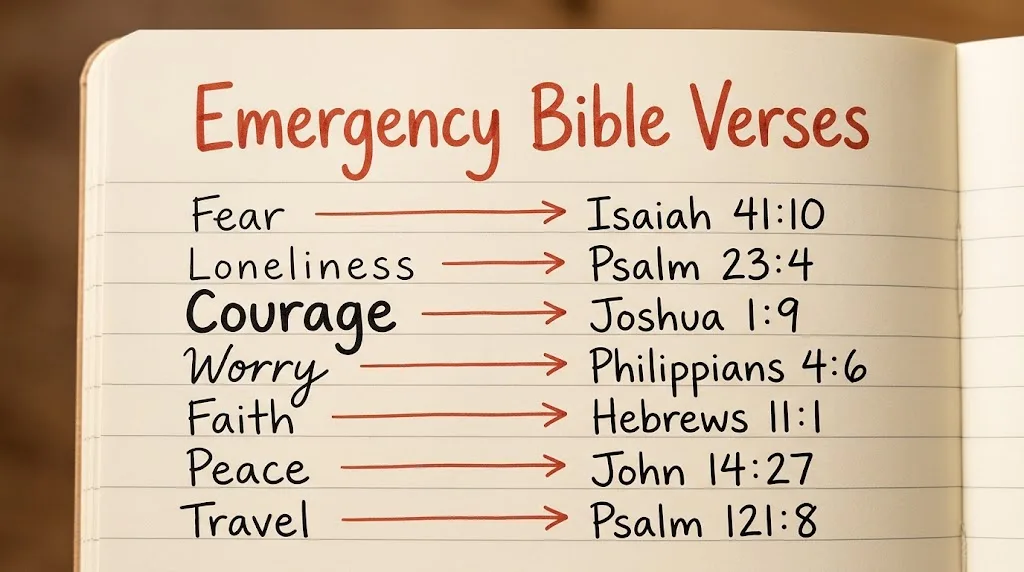
22 Emergency Bible Verses to Keep Close
The idea is simple. Instead of searching for a passage when your mind is already tired or overwhelmed, keep a small list ready.
These references are not magic numbers. They are starting points for reading the Bible in context, praying, and remembering themes such as God’s presence, mercy, wisdom, courage, and peace.
| When You Feel… | Read | Main Theme |
|---|---|---|
| Emotionally low | Psalms 42–43 | Hope when your soul feels downcast |
| Lonely | Psalm 23 | God’s presence and guidance |
| Afraid | Isaiah 41:10 | Strength and reassurance |
| In need of courage | Joshua 1:9 | Courage rooted in God’s presence |
| Worried | Matthew 6:25–34 | Trust instead of constant worry |
| Anxious | Philippians 4:6–7 | Prayer and peace |
| In danger | Psalm 91 | Refuge and protection |
| Far from God | Psalm 139 | God’s presence wherever you are |
| Weak in faith | Hebrews 11 | Examples of faith and endurance |
| Guilty after sin | Psalm 51 | Repentance and mercy |
| Bitter toward someone | 1 Corinthians 13 | Patience, humility, and love |
| Hurt by people | Colossians 3:12–17 | Compassion and forgiveness |
| Confused | Proverbs 3:5–6 | Trust and direction |
| Discouraged | Galatians 6:9 | Do not give up doing good |
| Tired | Matthew 11:28–30 | Rest for the weary |
| Unsure about your faith | Romans 8 | Grace, hope, and assurance |
| Proud | Psalm 19 | Honest self-examination |
| Praying with wrong motives | James 4:3 | Examining what you ask for |
| Worried about provision | Matthew 6:31–34 | Trusting God one day at a time |
| Starting a journey | Psalm 121 | God watching over your coming and going |
| Wanting a fruitful life | John 15 | Remaining connected to Christ |
| Let down by people | Psalm 27 | Confidence when human support fails |
When You Feel Emotionally Low: Psalms 42–43
These two Psalms speak openly about a downcast soul. They do not pretend sadness is small or simple.
At the same time, they repeatedly turn attention toward hope in God. That makes them a useful place to read when you cannot easily put your feelings into words.
Important: Scripture can be part of spiritual support, but it is not a replacement for mental health care. If you may harm yourself or are in immediate danger, contact emergency services or a crisis service in your country now.
When You Feel Lonely: Psalm 23
Psalm 23 uses the image of God as a shepherd who guides, provides, stays near, and walks with His people through dark places.
Read the whole Psalm rather than pulling out only one sentence. Notice how the passage moves from provision to difficulty and then back to confidence.
When You Need Courage: Joshua 1:9
Joshua faced a large responsibility when he was told to be strong and courageous. The reason for courage in the passage is not personal confidence. It is the assurance that God would be with him.
This is a good reference to write down before a difficult conversation, a major decision, or a new season that feels intimidating.
When You Cannot Stop Worrying: Matthew 6:25–34
Jesus addresses worry about everyday needs in this section of Matthew. The passage points away from trying to control every future problem at once.
A practical way to read it is one paragraph at a time. Ask what belongs to today and what you are carrying that has not happened yet.
When Anxiety Is Loud: Philippians 4:6–7
This passage connects worry with prayer, thanksgiving, and God’s peace.
It does not say that difficult circumstances disappear immediately. Instead, it gives the reader something concrete to do with anxious thoughts: bring specific concerns to God in prayer.
When You Feel Unsafe: Psalm 91
Psalm 91 uses strong images of refuge, shelter, and trust.
Read it as a prayer of dependence, not as a promise that a believer will never experience difficulty. Biblical faith does not require ignoring sensible safety steps or refusing practical help.
When God Seems Far Away: Psalm 139
Psalm 139 reflects on God’s knowledge and presence. The writer asks where he could go away from God’s Spirit and describes God’s presence across every place.
This makes it especially useful when prayer feels dry or when you feel spiritually distant.
When Your Faith Feels Weak: Hebrews 11
Hebrews 11 gathers stories of people who acted in faith without seeing every outcome first.
Do not rush through the chapter as a list of heroes. Look at how often faith involved waiting, uncertainty, obedience, or endurance.
When You Have Sinned: Psalm 51
Psalm 51 is a prayer of repentance. It is direct about guilt, mercy, cleansing, and the desire for a changed heart.
It is useful when you need something more honest than simply feeling bad about what happened. The passage turns regret toward confession and restoration.
When You Feel Bitter: 1 Corinthians 13
This chapter is often read at weddings, but its description of love is also a challenging mirror for ordinary relationships.
Read it slowly when resentment, impatience, pride, or harsh judgment starts shaping the way you treat another person.
When You Are Confused: Proverbs 3:5–6
This short passage is about trusting God rather than treating your own understanding as complete.
It does not remove the need to think carefully. It reminds you to seek direction with humility instead of assuming you can see every part of the situation.
When You Are Discouraged: Galatians 6:9
Galatians 6 encourages believers not to become tired of doing good.
This is especially useful during work that feels slow, unnoticed, or repetitive. Faithfulness often looks less dramatic than motivation.
When You Need Rest: Matthew 11:28–30
Jesus speaks directly to people who are weary and burdened.
Use this passage when exhaustion is making everything feel heavier. Read it slowly rather than treating rest as another task to complete.
When You Need Christian Assurance: Romans 8
Romans 8 brings together several major Christian themes: life in Christ, the Spirit, weakness, hope, prayer, God’s purpose, and enduring love.
If one verse feels too small for what you are facing, read the whole chapter and follow the argument from beginning to end.
When Money Feels Tight: Matthew 6:31–34
This passage addresses worry about basic needs. It should not be read as a promise that money will suddenly appear or that financial planning is unnecessary.
Its focus is trust, priorities, and refusing to let tomorrow’s worries consume today.
When You Travel: Psalm 121
Psalm 121 is a natural passage to read before a trip because it speaks about help, protection, and God watching over your coming and going.
You can write the reference at the top of a travel journal or save it with your trip notes as a simple prayer prompt.
When You Want Your Life to Be Fruitful: John 15
John 15 uses the picture of a vine and branches. The emphasis is not on frantic productivity but on remaining connected to Christ.
It is a helpful chapter when you are measuring your life only by output, achievement, attention, or visible results.
How to Make Your Own Emergency Bible List
- Choose 8 to 12 situations you actually face. Your list does not need every possible emotion.
- Write only the reference at first. This encourages you to open the Bible and read the passage in context.
- Use one color for the situation and another for the reference. It makes a notebook page easier to scan.
- Leave space for notes. Add one sentence about what stood out after you read.
- Update the list. Replace passages when another Scripture becomes more meaningful for that situation.
Tip: Keep the list inside your Bible, journal, notes app, or beside your bed. The goal is not to collect references. It is to make it easier to open Scripture when you do not know where to begin.
Frequently Asked Questions
What are emergency Bible verses?
They are simply Bible passages saved for specific difficult moments, such as fear, loneliness, worry, discouragement, guilt, or uncertainty. The phrase is a memory tool, not a special category of Scripture.
What Psalm should I read when I feel alone?
Psalm 23 is a common starting point because it focuses on God’s guidance and presence. Psalm 139 is another useful choice when God feels distant.
What Bible passage should I read when I am worried?
Matthew 6:25–34 addresses worry directly. Philippians 4:6–7 is another short passage about bringing concerns to God through prayer.
What should I read when my faith feels weak?
Hebrews 11 gives many examples of faith under uncertainty. Romans 8 is also useful when you need a broader reminder of Christian hope and assurance.
Should I only read the single verse listed?
No. The reference is a starting point. Reading the surrounding paragraph or whole chapter usually gives a clearer understanding of what the passage means.
Sources and Further Reading
For another organized list of Scripture readings for difficult moments, see Bible Gateway’s Emergency Bible Verses.
If emotional distress becomes a safety crisis, seek immediate real-world support. In the United States, 988 Suicide & Crisis Lifeline is available by call, text, or chat.