Table of Contents
Sometimes the hardest part of a quiet time is simply knowing where to start. You have a steaming cup of coffee in one hand, your favorite highlighter in the other, and your Bible open to a passage you desperately want to understand. Yet staring at the page can feel overwhelming. This is exactly where a framework becomes a gift. Acronym-based Bible study methods like SOAP, and its extended family of R, E, I, O, A, and P techniques, offer a gentle path into Scripture. They break down the process into simple, memorable steps, turning a monologue into a rich, two-way conversation with God. You don’t need a theology degree or a stack of commentaries; you just need a willing heart and a pen.
Why a Structured Method Matters
We often approach Scripture with the vague intention of “reading more,” but without a clear plan, our eyes can skim over words without our hearts ever engaging. A structured method provides a handrail. It slows you down, asks specific questions, and creates space for reflection. Rather than rushing through a chapter just to check it off a list, these acronyms teach you to linger over a single verse or a short passage. This shift transforms study from a passive intake of information into an active pursuit of wisdom and personal application. The goal isn’t just knowledge; it’s transformation, and a consistent pattern helps you get there.
Breaking Down the Acronyms
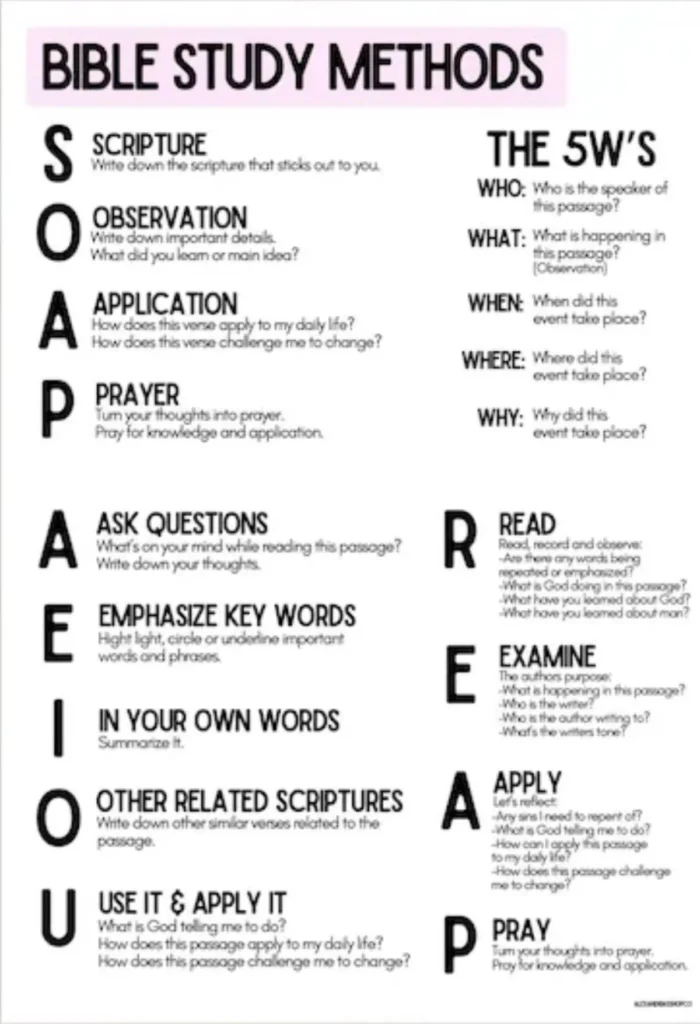
The beauty of these methods lies in their flexibility. You can use one exclusively for a season or cycle through different ones depending on the genre of Scripture you are reading. Each letter represents a deliberate pause, a moment to ask the Holy Spirit to illuminate the text. Let’s walk through the seven distinct approaches tied to the letters S, O, A, P, R, E, I, O, A, and P. While SOAP stands as the most popular foundation, the others layer in beautiful depth.
SOAP: The Classic Foundation
If you have ever searched for guided journaling techniques, you have likely bumped into the SOAP method. It is beloved for its simplicity. The “S” calls you to write out the Scripture passage longhand. There is something powerful about slowing down to physically form the words on a page; it helps cement them in your mind. The “O” stands for Observation. Here, you ask what you see. Who is speaking? Who is the audience? Are there repeated words or commands? The “A” pushes you toward Application, making the ancient text intersect with your modern life. Finally, “P” is Prayer, where you turn your observations and applications into a personal conversation with God.
R: The Art of Divine Reading
The “R” in this sequence invites you to slow down in a way that feels countercultural. It stands for Read, but with an emphasis on meditative repetition. This isn’t about scanning a chapter quickly. It is often linked to the ancient practice of Lectio Divina. You read a short passage several times, perhaps aloud, perhaps in a different translation each time. The goal is to listen for a specific word or phrase that the Holy Spirit seems to be highlighting for you. It’s less about dissecting grammar and more about absorbing tone and emotion. You are reading to hear a whisper, not just to analyze a historical document.
E: Engaging the Whole Story
While we often jump straight to personal application, “E” reminds us to Examine the context. A text without a context is a pretext for a prooftext, and that can lead to serious misunderstanding. This step asks you to look at the historical and literary backdrop. What type of book are you in—poetry, prophecy, a New Testament letter? What was the cultural situation of the original audience? Taking a few moments to place the verse within the grand narrative of redemption protects you from making the Bible all about yourself. You are asking what the passage meant to the original hearers before asking what it means for you today.
I: The Mirror of Interpretation
Sometimes we read commands in Scripture and our first instinct is to think of someone else who really needs to hear that verse. The “I” in this lineup stands for Interpretation, but specifically it turns the lens inward. After you have examined the objective meaning, you interpret the subjective pull on your own life. You ask, “What does this text reveal about God’s character, and what does it reveal about my human nature?” This step bridges the gap between the theological truth on the page and the messy reality of your heart. It is a moment of honest self-reflection, where you allow the living Word to read you.
O: Beyond the Surface
You might have noticed we already used an “O” in SOAP for Observation, but here it deepens the practice. This second “O” encourages an Overflow of study. It pushes you beyond the immediate paragraph to cross-reference other parts of Scripture. This is where a chain reference in your Bible or a quick search in a concordance shines. You start to investigate how the broader canon sheds light on a particular doctrine or phrase. If Jesus quotes an Old Testament passage, you go back and read the original context. This weaving together of the whole Bible creates a rich, cohesive understanding of who God is.
A: The Action of Worship
The second “A” in the sequence moves from internal reflection to outward response. While we applied the Word in SOAP, this “A” frames it as an Act of living sacrifice. It is the commitment step. You move from saying “I need to trust God more” to specifically writing down how you will do that today. Maybe it is a phone call you need to make, a financial gift, or a specific sin you need to confess to a safe person. It takes the abstract idea of faith and puts tangible hands and feet on it. This transforms Bible study from a quiet, passive absorption into a launching pad for active discipleship and obedience.
P: The Promise and Posture
The final “P” pivots from your actions back to God’s faithfulness. This stands for Promise and Posture. As you finish your study time, you specifically look for a promise to cling to for the rest of the day. Is there a promise of God’s presence, provision, or peace in the text? You then solidify your posture, meaning the physical and emotional stance of your spirit. You might physically kneel, lift your hands, or simply sit with open palms. This is a somatic way of sealing the study, reminding your body that you are a receiver of grace, and you leave the session with a promise tucked into your pocket, ready to be recalled when the day gets noisy.
Gathering Your Simple Tools
One of the joys of these methods is that they don’t require an expensive setup. While a beautifully leather-bound journaling Bible is lovely, a simple notepad and a reliable pen work perfectly. Many people find it helpful to have a standard Bible for marking and a journal or loose-leaf paper for writing. Writing the scripture by hand, rather than typing it, can be a key part of the meditative process. A pack of highlighters without any bleed-through is useful for marking repeated themes, but colored pencils also work in a pinch. The goal is to remove friction, so keep your tools in a basket by your favorite chair, ready for your early morning appointment.
Weaving the Methods Into a Daily Practice
You do not need to perform every single letter of S-R-E-I-O-A-P in one sitting. That would likely feel like a class assignment. Instead, view this collection of letters as a toolbox. Some days, a classic SOAP journal entry is all you need. On days when a passage feels puzzling, you might borrow the “E” for Examine to dig into a commentary. When your heart feels hard and resistant, leaning heavily into the second “A” for Action can break through spiritual stagnation. The rhythm might look different during Advent compared to a study through the book of Psalms. Give yourself permission to experiment and listen to what method fits the season your soul is in, allowing the framework to be a servant, not a tyrant.
Useful Tips for Sustainable Journaling
Starting a new habit is exhilarating, but maintaining it past the two-week mark requires a bit of strategy. First, set a realistic time limit. You absolutely can enjoy a rich, deep study in fifteen focused minutes. If you tell yourself you need an hour, you will likely skip it when the morning gets chaotic. Second, don’t get stuck on the writing. This journal is not for publication. Spelling errors, messy handwriting, and raw, unfiltered thoughts are the evidence of a real relationship, not a polished performance. Finally, keep your place with a ribbon or tab. If you are methodically walking through a book of the Bible, marking the date after each entry gives a beautiful visual trajectory of your growth over time, encouraging you to show up again tomorrow.
Frequently Asked Questions
Which method is best for a complete beginner?
If you are brand new to personal Bible study, the SOAP method is the most accessible gateway. It strips away the complexity and focuses strictly on reading a passage, noting a detail, finding a way to live it out, and praying about it. There is no pressure to know historical backgrounds or Greek definitions. You simply bring what you have and who you are to the text. Once SOAP becomes a comfortable rhythm, you can begin integrating the “E” (Examine) step occasionally when you have a little more time, slowly building your confidence muscle by muscle.
What if I don’t understand the passage I am reading?
It is completely normal to hit passages that feel confusing or culturally distant. When this happens, rely heavily on the “R” (Read) step. Try reading the passage again in a paraphrased version or listening to an audio reading on your phone. Often, hearing the cadence of the words unlocks meaning. If confusion remains, don’t panic. Make a note of your question and move on. You can always return later with a trusted online commentary or ask a mature friend. God honors your effort even when you don’t have perfect clarity, and some questions are meant to keep us humble and seeking.
Can I do this with my family or in a small group?
Absolutely, and it can be incredibly fruitful. In a group setting, you might ask everyone to read a short passage silently and work through a condensed SOAP journal individually for five minutes. After that, you can come back together to share your “O” (Observation) or “A” (Application) without any pressure to share the vulnerable prayer part aloud. This allows for a richness of perspective. You will be amazed at how a passage you read and thought was just for you can have a completely distinct and equally powerful observation from the person sitting right next to you, reminding you that Scripture is living and active.
Is it okay to not do every single letter every day?
Yes, and I would strongly encourage you not to attempt the full sequence of seven letters every single morning. The acronym S-R-E-I-O-A-P is meant as a vibrant menu, not a rigid checklist. Some days, you might wake up burdened and simply need the “P” (Promise and Posture), spending your entire time sitting in stillness and receiving God’s promises. On a day when you feel distant, the second “A” (Action) might convict you to write an apology note or schedule a coffee date. Let the Holy Spirit guide the emphasis, allowing the framework to serve your relationship rather than turning your quiet time into an academic duty.
Making the Table a Little Wider
In a world that constantly demands our attention and screams that we aren’t enough, sitting down with an open Bible feels like a quiet act of defiance. It is a declaration that we need a voice outside of ourselves. The SOAP and R-E-I-O-A-P frameworks are simply invitations. They are gentle guides that pull out a chair at the breakfast table and invite you to sit with the God who created language, beauty, and story. You don’t have to be perfect to meet Him there. You just have to show up, ask genuine questions, and write down what you find. The journey isn’t about filling up a perfect notebook; it’s about allowing the Author of life to fill up the empty pages of your heart. So pick up that pen, find a quiet corner, and let the living words on the page begin to reshape the living words of your day.