Table of Contents
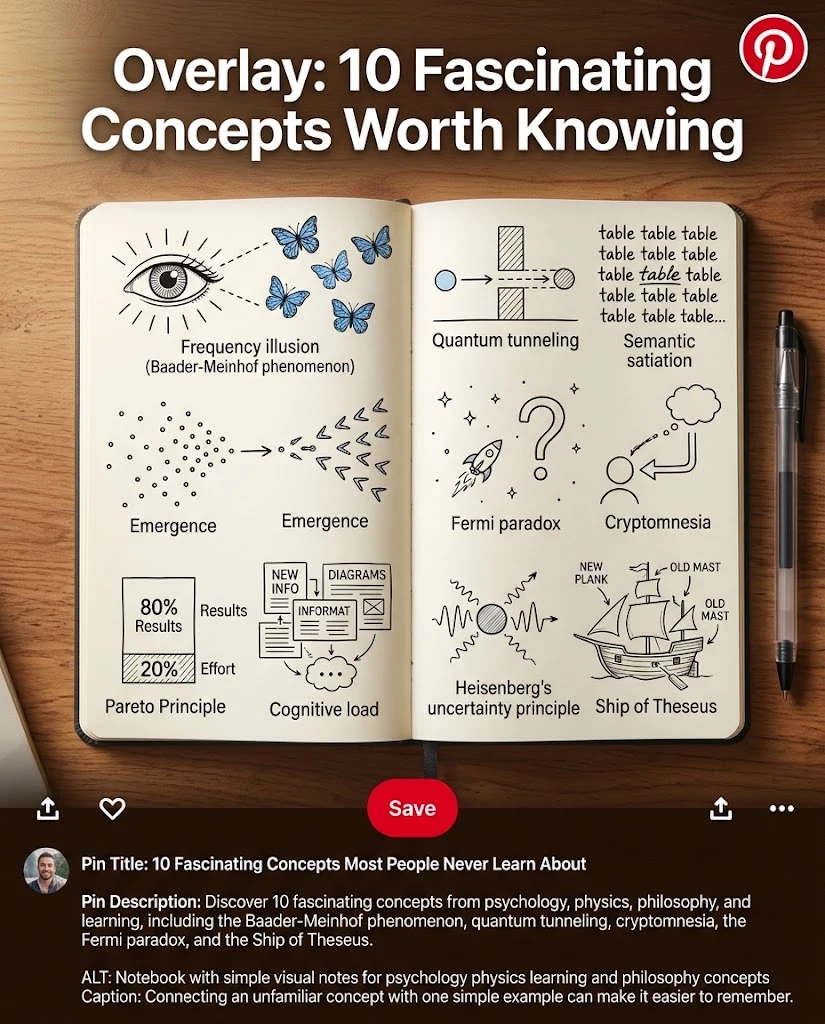
- 10 Fascinating Concepts at a Glance
- 1. Baader-Meinhof Phenomenon: Why You Suddenly See Something Everywhere
- 2. Quantum Tunneling: Crossing a Barrier the Classical Way Says You Should Not
- 3. Semantic Satiation: When a Familiar Word Starts Sounding Strange
- 4. Emergence: When Simple Parts Create Something More Complex
- 5. The Fermi Paradox: If Alien Civilizations Exist, Where Is Everybody?
- 6. Cryptomnesia: When an Old Memory Feels Like Your New Idea
- 7. Pareto Principle: The Famous 80/20 Idea
- 8. Cognitive Load Theory: Why Too Much Information Makes Learning Harder
- 9. Heisenberg’s Uncertainty Principle: A Limit Built Into Quantum Physics
- 10. The Ship of Theseus: What Makes Something the Same Thing?
- What These 10 Ideas Have in Common
- Frequently Asked Questions
- Sources
Some ideas give a name to things you have experienced without realizing it. These 10 fascinating concepts come from psychology, physics, philosophy, economics, and learning science, and each one explains a surprising part of how the mind or world works.
- Concepts: 10
- Topics: Psychology, physics, philosophy, learning, and decision-making
- Reading level: Beginner-friendly
- Goal: Understand each idea without technical jargon

10 Fascinating Concepts at a Glance
| Concept | Field | Simple Idea |
|---|---|---|
| Baader-Meinhof Phenomenon | Psychology | You notice something everywhere after first becoming aware of it. |
| Quantum Tunneling | Physics | A quantum object can have a probability of appearing across an energy barrier. |
| Semantic Satiation | Psychology | A repeated word can temporarily feel meaningless. |
| Emergence | Science & Philosophy | Complex systems can show properties their individual parts do not have. |
| Fermi Paradox | Astronomy | If technological life could be common, why have we found no clear evidence of it? |
| Cryptomnesia | Psychology | A forgotten memory can return and feel like a new idea. |
| Pareto Principle | Decision-Making | A small share of causes can sometimes produce a large share of results. |
| Cognitive Load Theory | Learning | Working memory has limited capacity. |
| Uncertainty Principle | Physics | Certain pairs of quantum properties cannot both have arbitrarily precise values. |
| Ship of Theseus | Philosophy | If every part of something is replaced, is it still the same thing? |
1. Baader-Meinhof Phenomenon: Why You Suddenly See Something Everywhere
You learn a new word on Monday. By Friday, you feel as if you have heard it ten times.
This experience is commonly called the Baader-Meinhof phenomenon. A more descriptive name is the frequency illusion.
The thing may not have suddenly become more common. Your attention changed. Once something becomes important enough to notice, occurrences that previously passed unnoticed can start standing out.
A simple example is buying a particular model of car and then noticing the same model on every road.
Why it matters: Noticing something more often does not automatically mean it is actually happening more often.
2. Quantum Tunneling: Crossing a Barrier the Classical Way Says You Should Not
Imagine a ball trapped in a valley with a hill so high that the ball does not have enough energy to roll over it. In ordinary classical physics, it stays trapped.
Quantum systems behave differently. A particle is described by a quantum state that can extend into a barrier. This creates a probability that the particle will be detected on the other side.
That effect is called quantum tunneling.
It does not mean an everyday object can simply walk through a wall. Quantum tunneling becomes important at microscopic scales and in carefully designed quantum systems.
The phenomenon matters in areas such as nuclear physics, chemistry, electronics, and quantum technology.
3. Semantic Satiation: When a Familiar Word Starts Sounding Strange
Try saying a simple word such as “door” over and over.
After enough repetitions, the word may briefly stop feeling connected to its meaning. It can start sounding like a strange collection of noises.
Psychologists call this semantic satiation.
The American Psychological Association describes it as an effect in which repeated exposure can make a word seem to temporarily lose its meaning.
The word has not changed. What changes temporarily is your experience of the connection between the sound or written form and the concept it represents.
4. Emergence: When Simple Parts Create Something More Complex
Emergence is the broad idea that interactions among simpler parts can produce larger patterns or properties that the individual parts do not display by themselves.
Think about a flock of birds. No single bird contains the shape of the entire flock. The larger pattern appears through many birds responding to one another.
Similar discussions appear in fields ranging from complex systems to biology, philosophy, and studies of consciousness.
There is an important detail here: emergence does not have one universally agreed definition. Researchers and philosophers distinguish different versions, including weaker and stronger forms of emergence.
5. The Fermi Paradox: If Alien Civilizations Exist, Where Is Everybody?
The Milky Way is extremely old and contains an enormous number of stars and planets.
That leads to a famous puzzle associated with physicist Enrico Fermi. If technologically advanced civilizations are common and some could spread through the galaxy, why have we not found clear evidence of them?
This tension is called the Fermi paradox.
There is no confirmed solution. Possible explanations range from intelligent life being rare to interstellar expansion being much harder than expected.
The important point is that the paradox is a question, not evidence that aliens definitely exist or definitely do not exist.
6. Cryptomnesia: When an Old Memory Feels Like Your New Idea
You think of a melody, sentence, joke, or creative idea and believe you invented it.
Later, you discover that you encountered something very similar years ago.
That can be an example of cryptomnesia.
The American Psychological Association describes it as an implicit memory effect in which someone mistakes a previously encountered idea for a new creation because the original encounter has been forgotten.
The person is not necessarily copying deliberately. They may genuinely experience the remembered material as an original thought.
7. Pareto Principle: The Famous 80/20 Idea
The Pareto principle is often summarized as the 80/20 rule.
The basic idea is that, in some systems, a relatively small share of inputs accounts for a much larger share of results.
For example, a business might discover that a small group of products produces most of its sales. A person might find that only a few recurring problems cause most of their wasted time.
But 80 and 20 are not universal laws. Real-world ratios can be 70/30, 90/10, or something completely different.
Useful question: Instead of assuming everything contributes equally, ask which few inputs are producing most of the result.
8. Cognitive Load Theory: Why Too Much Information Makes Learning Harder
Working memory cannot handle unlimited amounts of new information at the same time.
Cognitive load theory studies what happens when a learning task demands more mental processing than working memory can comfortably manage.
Imagine trying to follow a difficult explanation while also reading unrelated text, remembering several numbers, and watching a complicated diagram. Even if each piece is understandable by itself, the combination can make learning harder.
This is one reason clear instructions often break difficult tasks into smaller steps.
The idea is especially important in education and instructional design. It does not mean all difficult thinking is bad. Learning itself can require effort. The goal is to avoid unnecessary mental load that competes with the material you actually need to understand.
9. Heisenberg’s Uncertainty Principle: A Limit Built Into Quantum Physics
The uncertainty principle is often explained badly as, “Scientists disturb a particle when they measure it.”
That is not the full idea.
In quantum mechanics, some pairs of properties have a fundamental relationship that limits how sharply both can be specified at the same time.
The famous example is position and momentum.
Making the possible position of a particle more tightly defined is associated with a broader range of possible momentum values, and vice versa.
This is a feature of the mathematical structure of quantum mechanics, not simply a problem caused by clumsy measuring equipment.
10. The Ship of Theseus: What Makes Something the Same Thing?
Imagine an old wooden ship.
One damaged plank is replaced. Years later, another is replaced. Eventually every original plank has been replaced.
Is it still the same ship?
Now make the puzzle harder. Imagine someone saved all the old planks and later rebuilt another ship from them. Which ship deserves to be called the original?
This is the Ship of Theseus problem, one of philosophy’s classic puzzles about identity over time.
The puzzle has no simple agreed answer. That is what makes it useful. It forces us to ask whether identity depends on physical material, continuous history, structure, function, or something else.
What These 10 Ideas Have in Common
At first, these concepts seem unrelated. One talks about words, another about particles, another about alien civilizations.
But each challenges an assumption that feels obvious.
- What you notice is not always what became more common.
- Everyday physical intuition does not always work at quantum scales.
- Memory does not always tell you where an idea came from.
- More information does not always improve learning.
- Simple parts can create surprising larger patterns.
- Even the meaning of “the same object” becomes difficult when you examine it closely.
That is why learning a concept can be useful even if you never study the entire field behind it. A good concept gives you a new question to ask.
Frequently Asked Questions
Is the Baader-Meinhof phenomenon real?
The experience is commonly discussed as the frequency illusion. Once something captures your attention, you may notice its later appearances more readily than you did before.
Is the Pareto principle always exactly 80/20?
No. The numbers are a useful shorthand, not a rule that every system must follow exactly.
Is quantum tunneling only theoretical?
No. Quantum tunneling is an established quantum phenomenon and is observed in real physical systems.
Is the Fermi paradox proof that aliens exist?
No. It describes the tension between some expectations about technological civilizations and the lack of confirmed evidence for them. It does not prove extraterrestrial civilizations exist.
Does the Ship of Theseus have a correct answer?
There is no single answer accepted by every philosopher. The value of the thought experiment is the problem it exposes about how we define identity through change.
Sources
Definitions and explanations in this guide were checked against the American Psychological Association, American Physical Society, NASA, SETI Institute, Stanford Encyclopedia of Philosophy, and educational psychology research.