Table of Contents
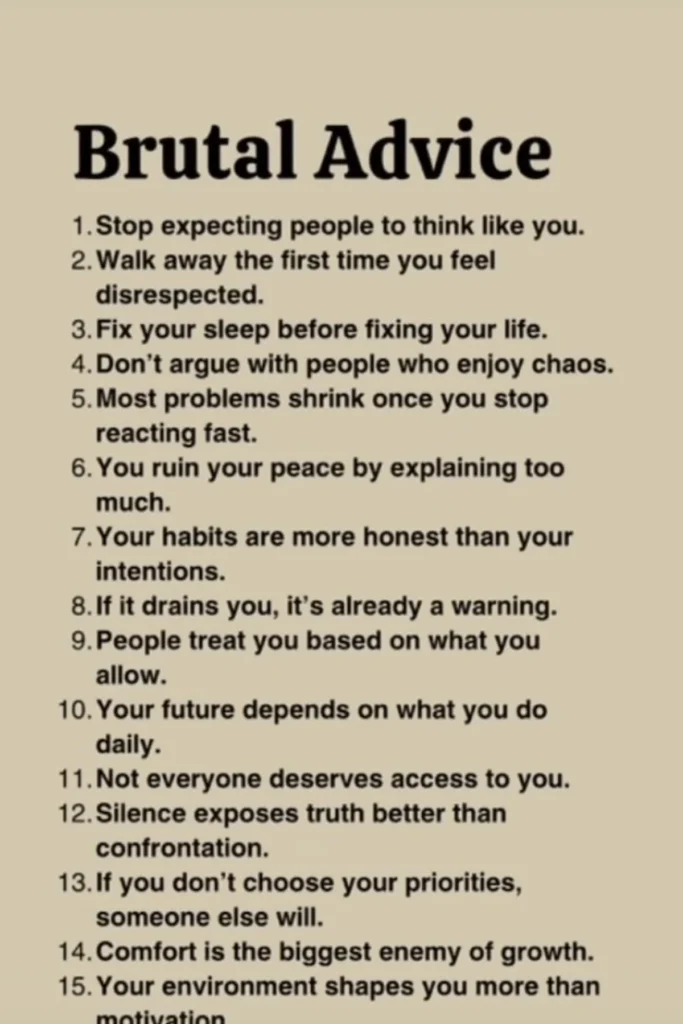
Most of the aspirational quotes we save on our phones are designed to make us feel warm and fuzzy for about five minutes. But the path to a deeply fulfilling life rarely starts with a gentle pat on the back. It often begins with a mirror being held up to your face, reflecting the parts of your character and habits you have been actively avoiding. The advice that actually changes your trajectory is not the kind that comforts your current state; it is the kind that disrupts it. Brutal advice for a more fulfilling life is not about being cruel to yourself. It is about being dangerously honest. It is about recognizing that the soft, pillowy safety of your comfort zone is the very thing suffocating your potential.
Why Hard Truths Matter More Than Comforting Lies
We live in a culture that pathologizes discomfort. We view anxiety as a malfunction rather than a signal, and we treat sadness as a problem to be medicated away rather than a human experience to be processed. The issue with a life built entirely on seeking comfort is that it becomes brittle. When you construct your reality to avoid all triggers, criticism, and failure, you rob yourself of the grit required to handle basic living. A fulfilling life is not a pain-free life; it is a resilient one. Hard truths act as antibodies for the psyche. They sting upon entry, but they build an internal immune system that prevents you from crumbling when the real storms arrive.
Stop Performing “Wellness” and Start Living It
There is a massive industry dedicated to making you look like you have your life together. Aesthetic morning routines, matching activewear, and impeccable green smoothies photographed in golden hour lighting are often a performance of health rather than a state of being. Brutal honesty forces you to ask whether you are actually doing the work or simply staging it for an audience—even if that audience is just your own ego. True fulfillment comes from the ugly, unphotographed moments. It comes from the therapy session where you sob unexpectedly, the workout where you fail a rep, and the messy apology you make to someone you hurt. If your wellness practice exists solely for consumption by others, it has no nutritional value for your soul. The brutal truth is that nobody needs to see your journal to validate that you are healing.
You Are the Common Denominator in Your Own Chaos
There is an uncomfortable moment in the journey toward maturity when you realize you are not a victim of a vast cosmic conspiracy. The messy relationships, the recurring financial stress, and the constant career stagnation often have one glaringly obvious common denominator: you. This realization is brutal because it strips away the safety net of blame. It is psychologically easier to believe the world is unfair to you than to admit you have poor boundaries, a fragile ego, or a lack of discipline. But the moment you accept radical responsibility for your current situation, you simultaneously gain the power to change it. You cannot edit how other people behave, but you can change your habit of tolerating disrespect. You cannot control the economy, but you can stop impulse spending on things you don’t need to impress people you don’t like. A fulfilling life begins when your locus of control shifts from external fate to internal agency.
The Seductive Trap of Learned Helplessness
Many intelligent people use their analytical skills not to build strategies, but to construct elaborate excuses. You can be incredibly creative in justifying why you cannot apply for a new job, start a fitness routine, or leave a toxic partner. You convince yourself that you are simply “being realistic,” but in reality, you are practicing learned helplessness. Life satisfaction remains elusive because you have taught your brain that your efforts do not matter. Breaking this cycle requires a crude, practical interruption. You must prove to yourself that your actions create results, starting with something embarrassingly small. Make your bed. Drink a glass of water immediately upon waking. Answer one avoided email. These small completions are proof of life, evidence that you are not passively coasting toward the grave but actively steering the boat.
The “Happiness Trap” Is Real
The frantic, obsessive pursuit of happiness is paradoxically the fastest track to misery. Chasing a constant state of euphoria is like trying to catch smoke with your bare hands; the tighter you squeeze, the more it dissipates. Happiness is a transient emotion, a fleeting visitor rather than a permanent resident. The moment you label the mundane neutrality of a Tuesday afternoon as “boredom” or “depression,” you trigger a craving for artificial stimulation that leads to burnout. A more fulfilling life is built on the sturdy foundation of meaning, not the shifting sands of mood. Meaning often comes wrapped in discomfort. It lives in the discipline of showing up for a difficult task, the sacrifice of raising children, or the vulnerability of creating art that might be ridiculed. Brutal advice for a more fulfilling life demands that you stop asking “Am I having fun?” and start asking “Am I contributing, connecting, and growing?”
Why Meaning Requires a Side of Suffering
If you remove all friction from your life, you smother all satisfaction. A video game without challenge is boring; a life without struggle is empty. You need to voluntarily choose to do hard things. This is why physical exercise is a non-negotiable metaphor for living well. When you lift something heavy or run a long distance, you are performing a transaction of discomfort for endorphins and strength. The same logic applies to difficult conversations. Avoiding a tough call with a family member feels good in the short term, but the festering resentment destroys the relationship over time. Choosing the hard path, the honest words, and the sweaty effort is the only transaction that purchases a genuine sense of capability.
Your Circle Is Your Ceiling
The people you surround yourself with are effectively programming your unconscious mind. You can have the most ambitious intentions in the world, but if your closest friends are cynical, stagnant, and addicted to drama, your trajectory will eventually align with theirs. This is a brutal calculus because it requires you to admit that you may have outgrown people you genuinely love. Sometimes the most fulfilling choice is to distance yourself from a childhood friend who mocks your ambition, or to set heavy boundaries with a parent whose criticism blocks your self-trust. You become the average of the five people you interact with most. If you look at those five people and feel a sinking horror about your future, you have identified the bottleneck in your growth. Loneliness in the short term is a price worth paying for a community that elevates rather than tolerates you.
Nobody Is Coming to Save You
Waiting for rescue is a childlike fantasy that many adults secretly harbor. We wait for the perfect partner to fix our insecurities, the perfect boss to recognize our genius, or the perfect lottery ticket to erase our debt. This passive waiting is a slow poison. The universe is neutral; it does not owe you a fulfilling life simply because you are a good person. The most liberating and terrifying truth you can accept is that the cavalry is not coming. You are the scout, the cavalry, and the medic. This realization is not a reason to despair; it is a reason to activate. When you stop expecting someone to hand you a permission slip for your own life, you start making the moves that matter. You update the résumé, you book the physical exam, you buy the plane ticket, and you start the business. Delaying your life until a magical future date is a guarantee of regret.
Practical Considerations for Radical Living
Implementing this kind of hard-edged honesty does not mean walking around with a scowl, barking orders at yourself. It is an interior practice of zero tolerance for self-deception. It requires you to become fluent in distinguishing between a genuine limitation and a lazy excuse. It also requires self-compassion, which is the surprising twin of brutal honesty. You can tell yourself, “I am being lazy and avoiding this task because I am afraid of failing,” without adding a layer of shame that paralyzes you further. Brutal advice works best when delivered with a tone of matter-of-fact curiosity rather than cruel judgment. You are simply calling the game clock and the scoreboard exactly as they are, so you know what adjustments to make.
Useful Tips for Embracing Radical Honesty
Shifting from a mindset of comfort-seeking to truth-seeking changes how you structure your day. It is a rewiring process that benefits from small, consistent challenges. Here are some practical ways to introduce this philosophy into your daily rhythm without shocking your system into a rebellion.
- Conduct a “locus of control” audit: Whenever you feel upset, write down the cause. Draw a circle around everything you can control—your reaction, your next step, your boundaries—and notice how much energy you waste on things outside the circle.
- Schedule “uncomfortable” tasks first: Your willpower is a finite battery. Perform your most avoided, difficult task of the day first. By facing the discomfort willingly, you reclaim your day from the dread that haunts your idle moments.
- Stop relitigating the past: Your parents made mistakes and your ex was terrible. You have told yourself the story a thousand times. It’s done. The brutal question is always, “What now?” Stop using past wounds as a get-out-of-jail-free card for current inaction.
- Pursue rejection: If you are terrified of being told “no,” you are living at the mercy of strangers. Repeatedly put yourself in situations where rejection is a likely outcome, whether in sales, dating, or creative pitching. Exposure therapy turns the feared negative outcome into a normal, forgettable Tuesday.
- Identify your “dangerous” comfort: Pick the one treat, habit, or person that you run to when you want to numb out. It might be a phone, a bottle of wine, or a video game. Observe it without judgment, but ask honestly if it is adding to your life only because it prevents you from looking at your life.
FAQ
Isn’t this “brutal advice” just a lack of empathy?
There is a massive difference between being harsh and being honest. Empathy involves sitting with someone in their pain and understanding it, but real empathy does not smile and nod at self-destructive behavior. Enabling a person’s delusions by validating every complaint is not care; it’s cowardice. True care involves the courage to say, “I love you, and I’m watching you sabotage yourself, and I’m not going to pretend I don’t see it.” Brutal advice should always be delivered from a place of goodwill, not contempt. Applying it to yourself is the highest form of self-care because it implies that you are worth the discomfort of growth.
How do I accept the “nobody is coming to save you” idea without feeling depressed?
The initial shock of that statement can feel like a cold, existential void. However, the depression usually stems from a residual fantasy that you were entitled to a rescuer in the first place. Once you process the disappointment, the statement becomes incredibly empowering. If nobody is coming, it also means nobody has the authority to veto your life. Nobody can give you permission, so nobody can take it away. The day you stop expecting a savior is the day you realize you are capable of picking up the oars and rowing. It is not depressing; it is the final dissolution of the victim role you have been playing.
What if I’m genuinely exhausted by the struggle? Is it okay to take a break?
Absolutely. Distinguishing between a strategic retreat and a cowardly surrender is a critical skill. Strategic rest is intentional—you step back to heal, to reassess, and to replenish your physical and mental resources. It is a specific, time-bound choice. Surrender, on the other hand, is an indefinite slumping into stasis. Brutal honesty requires you to label the break accurately. If you are lying in a dark room scrolling through social media comparing your burnout to everyone else’s highlight reel, you are not resting; you are hiding. True rest restores your capacity to return to the difficult work of living meaningfully.
Can I live a fulfilling life if I have truly failed at something massive?
A massive, public, or catastrophic failure is often the most fertile soil for a fulfilling life. This is not a cheap platitude; it is brutal practical psychology. When you have already lost the thing you were most afraid of losing—whether it’s a marriage, a career, or a reputation—you become unshackled. The fear of failure now lacks its primary teeth because the worst-case scenario has already happened and you survived. Many people never live a genuine life because they are too busy protecting a fragile structure of perfection. Failure burns that structure down; it is only once the fire is out that you can see the sky clearly for the first time. Rebuilding from scratch, with the wisdom of scars, is almost always a more authentic and deeply satisfying construction than the gilded cage that fell apart.
Taking the First Real Step
The desire for a fulfilling life can often become another item on your to-do list that you never check off. You do not need more information; you have enough. You do not need a life coach to whisper motivational secrets; you already know exactly which corner of your life you have been neglecting. Brutal advice for a more fulfilling life strips away the complex jargon and leaves you with a simple, sharp tool. Use it to cut the ropes of a ship that has been safely docked for too long. The harbor is comfortable, yes. It is also a museum for boats that were never meant to stay still. Your fulfillment is waiting in the open water, and the water, while rough and unpredictable, is exactly where you belong.