Table of Contents
- Why a Book About Small Talk Grabs Attention Right Now
- What the Cover Tells Us About the Approach
- Why Those Four Crossed-Out Phrases Matter So Much
- Practical Considerations Before You Start Reading
- Useful Tips for Applying What This Book Promises
- Who Might Pick Up This Bright Yellow Book
- Why the Promise of Real Friendship Stands Out
- Frequently Asked Questions About Better Small Talk
- How a Yellow Paperback Can Shift Your Perspective
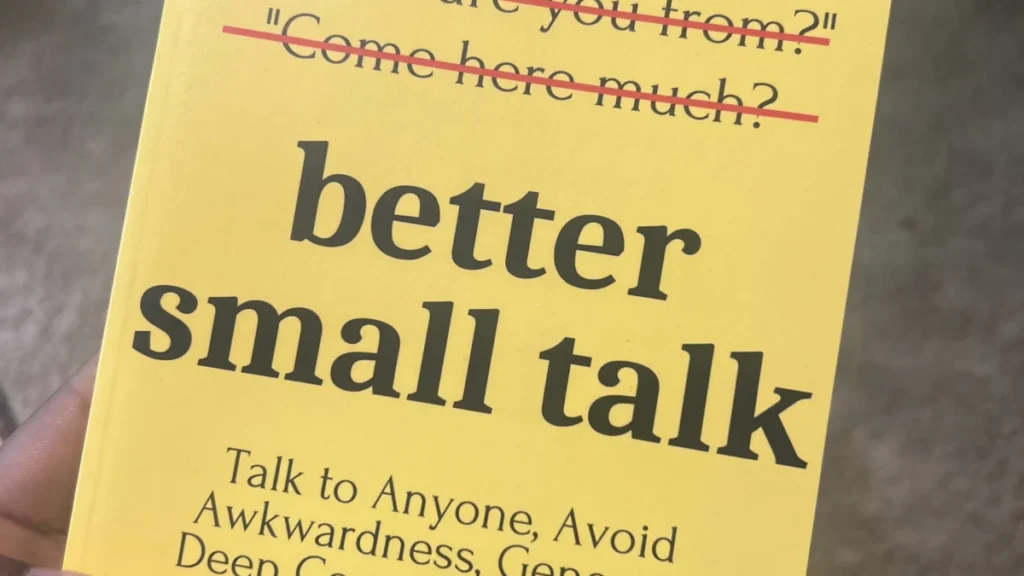
You know the moment. You are standing next to someone at a party, a coworker in the break room, or a friend-of-a-friend at a dinner, and your brain reaches for the nearest conversational life raft. Usually it is something about the weather, a bland observation about traffic, or the classic “So, what do you do?” The person holding the yellow paperback in front of us has clearly decided there has to be a better way. The book in their hand is Better Small Talk by Patrick King, and just looking at its cover feels like a gentle but firm intervention.
The cover does not whisper its intentions. It shouts them through crossed-out phrases printed right at the top. “Nice weather,” “So what do you do,” “Where are you from,” and “Come here much” are all slashed through with red horizontal lines. Before you even read the subtitle, the book has already diagnosed the problem. The promise sitting underneath those rejected clichés is a full-on upgrade to how we connect: Talk to Anyone, Avoid Awkwardness, Generate Deep Conversations, and Make Real Friends. That is a lot of hope packed into a bright yellow paperback, and it immediately makes you wonder what is behind the cover.
Why a Book About Small Talk Grabs Attention Right Now
The world has spent a strange few years rewiring how we socialize. Many people feel rusty, out of practice, or hyper-aware of how shallow surface-level chatter can feel. A book that openly crosses out the four most common crutches people lean on is instantly refreshing. It validates a quiet suspicion many of us carry: that repeating the same empty lines does not actually build bridges. The visual of the crossed-out phrases acts like a permission slip to want more from our daily interactions.
Patrick King has built a reputation around social skills and emotional intelligence, and this book is part of that larger body of work. Even without opening the pages, the cover tells you the focus is not on memorizing witty lines. The goal is to move past the awkwardness that makes people cling to “Where are you from?” in the first place. The jacket speaks directly to anyone who has ever felt exhausted by forced networking or surface-level mingling. It suggests that real connection is a skill you can practice rather than a personality trait you either have or lack.
What the Cover Tells Us About the Approach
You can learn a lot from a cover when it is designed this intentionally. The black and red typography on that bright yellow background is meant to be seen across a room, much like the conversational signals we send out. Rejecting the four standard openers is not just a design choice; it is a statement about method. This is not a book about polishing your small talk to be slightly more charming. It is about rethinking the goal of the interaction entirely.
The subtitle is broken into four distinct promises, and the order matters. First, talk to anyone, which speaks to accessibility and reducing the intimidation factor. Second, avoid awkwardness, which addresses the fear that keeps people silent. Third, generate deep conversations, which reveals the real target beneath the surface. Fourth, make real friends, which confirms that the endgame is not networking contacts but genuine human bonds. Any reader picking this up knows exactly what they are signing up for.
Why Those Four Crossed-Out Phrases Matter So Much
Let us sit with those rejected openers for a moment because they are practically universal. “Nice weather” is the ultimate filler, a signal that we have nothing else to say but feel obligated to break the silence. “So what do you do” reduces a whole human to their job title before you know a single interesting thing about them. “Where are you from” can be loaded with assumptions and rarely leads anywhere surprising. “Come here much” somehow manages to feel both intrusive and dull at the same time.
The cover treats these not as evil phrases but as lazy defaults. Crossing them out visually suggests that the reader already knows these are dead ends. You do not need a book to tell you they are shallow; you need a book to show you what to reach for instead. The red slashes are almost playful, like a friend teasing you for your go-to lines before handing over a better playbook. That tone matters because it frames learning social skills as a relief rather than a chore.
Practical Considerations Before You Start Reading
A book like this works best when you treat it as a workshop rather than a novel. The cover promises actionable outcomes like generating deep conversations, which implies exercises, mindset shifts, or frameworks inside. If you are holding this yellow paperback, it helps to have a specific setting in mind where you want to practice. Maybe it is your next work event, a family gathering, or simply chatting with neighbors you usually wave at from a distance.
It is also worth noting that unlearning old conversational habits takes a little humility. You will catch yourself starting to ask “So what do you do” out of muscle memory, and that is fine. The point is building awareness so you can pivot. The book’s bold cover acts as a visual anchor you can mentally recall when you feel yourself slipping into autopilot. Keep it somewhere visible on your shelf or nightstand as a reminder that the crossed-out phrases are no longer your go-to moves.
Useful Tips for Applying What This Book Promises
Although we cannot flip through the chapters here, the cover alone gives you enough to experiment with immediately. The next time you enter a conversation, try treating each crossed-out phrase as a friendly warning sign. If you hear yourself about to comment on the weather, pause and ask something slightly more specific about the person’s immediate experience. Instead of “Nice weather,” you might notice what they are holding, wearing, or looking at and mention that.
- Ban one opener at a time. Start by removing “So what do you do” from your vocabulary for a full week. Replace it with questions about what has been keeping someone busy or excited lately. You will notice the difference in energy almost immediately.
- Use the cover as a visual cue. Take a photo of the book on your phone or set the book jacket as a mental trigger before walking into a social situation. The crossed-out phrases remind you what to avoid.
- Practice depth in low-stakes settings. Try generating a slightly deeper conversation with a barista, a rideshare driver, or someone in line. These brief interactions are safe playgrounds where awkwardness carries very little risk.
- Let silence breathe. Awkwardness often comes from rushing to fill gaps. The book’s subtitle suggests avoiding awkwardness, not eliminating silence. A comfortable pause gives the other person room to offer something more meaningful.
- Follow genuine curiosity. The best way to make real friends, as the cover promises, is to actually care about the answer. Any technique you learn inside the book will work better when powered by real interest in the person in front of you.
Who Might Pick Up This Bright Yellow Book
The hand holding the book in the image has a manicured, pointed artificial nail, which hints that this reader cares about presentation and detail. The book is angled so we see the cover clearly, almost as if the person is showing it to a friend or recommending it. The background is softly out of focus, with carpet and furniture suggesting a cozy indoor setting, maybe a living room or reading nook. Everything about the scene feels intentional yet relaxed, the kind of environment where you would actually process ideas about better conversation.
This book will likely appeal to young professionals navigating networking events, introverts looking for a less draining way to socialize, and anyone re-entering in-person gatherings after a long stretch of isolation. It also speaks to people who are simply bored with their own conversational patterns and suspect they are capable of more meaningful connections. The cover is designed to catch the eye of someone who has heard “Nice weather” one too many times and is ready to laugh at it and move on.
Why the Promise of Real Friendship Stands Out
Many social skills resources stop at making a good impression or appearing confident. The final promise on this cover, “Make Real Friends,” raises the stakes considerably. It suggests that better small talk is not about performance but about opening a door to relationships that actually nourish you. That shift in framing turns casual conversation from a social obligation into a potential source of genuine belonging.
The progression on the cover mirrors how real connection works. You start by talking to anyone, which breaks down the barrier of selectivity. You avoid awkwardness, which removes the friction that drives people apart. You generate deep conversations, which builds substance and trust. Only then do you arrive at real friendship, which is the lasting reward. This logical flow suggests that Patrick King has structured the book around outcomes that build on each other rather than disconnected tips scattered across pages.
Frequently Asked Questions About Better Small Talk
Is Better Small Talk only for people who feel socially awkward?
Not at all. While the cover directly addresses avoiding awkwardness, the deeper promises of generating meaningful conversations and building real friendships appeal to anyone who wants richer social connections. Even people who feel perfectly comfortable in social settings sometimes realize their chats stay on the surface and rarely go deeper. The crossed-out conversation starters are universal crutches, not just nervous habits. Many confident talkers still fall back on “So what do you do” without realizing it is keeping an interaction at arm’s length.
Does the book suggest specific questions to replace the crossed-out phrases?
While we cannot see inside the pages, the structure of the cover implies that the book offers alternatives that lead toward deeper conversation. The promise to “generate deep conversations” strongly suggests there are frameworks, examples, or principles for crafting better openers. A book that crosses out four common questions without offering replacements would leave readers stranded, which goes against the helpful, solution-oriented tone of the subtitle. The design indicates that readers will walk away knowing exactly what to say instead.
Can Better Small Talk help in professional or networking settings?
The ability to talk to anyone and avoid awkwardness is directly useful in professional environments where first impressions matter. Networking events are notorious for surface-level exchanges that go nowhere, and the book’s focus on generating deeper conversations could help turn brief encounters into memorable connections. The cover does not limit itself to casual or social settings, suggesting the skills inside apply broadly. Building real friendships at work or in professional circles can also lead to more fulfilling career relationships.
Is this a good book for someone who identifies as an introvert?
The bright, approachable design and the playful crossing-out of cliché phrases make the book feel inviting rather than intense. Introverts often find scripted small talk exhausting because it feels inauthentic and energy-draining. A resource that promises to move past surface chat into deeper, more meaningful conversation aligns well with how many introverts prefer to connect. Skipping the weather talk and getting straight to substance can actually feel more natural and less performative for quieter personalities.
How long does it take to get better at small talk using this approach?
Any skill-building resource takes consistent practice, and social habits are no exception. The cover frames the outcomes as achievable goals rather than instant magic, which suggests that readers can start experimenting immediately with small shifts. The first win often comes from simply catching yourself before using one of the crossed-out phrases. From there, each interaction becomes a chance to try a different approach. Progress depends on how often you practice and how willing you are to feel a little awkward while trying new conversational paths.
How a Yellow Paperback Can Shift Your Perspective
There is something powerful about seeing your own conversational habits printed on a book cover and crossed out like a bad idea. It makes you laugh, maybe wince a little, and then feel genuinely curious about what is inside. The person holding Better Small Talk in the image is not hiding the cover or reading it discreetly. They are holding it out, angled toward the world, as if to say this is worth paying attention to.
The bright yellow jacket does exactly what a good conversation starter should do. It catches your eye, makes a specific promise, and invites you to engage further. Whether you are looking to stop dreading social events, build deeper connections, or simply retire “Nice weather” forever, this book appears ready to meet you where you are. The crossed-out phrases are not a scolding. They are an invitation to something better, and that yellow cover might just be the nudge your social life has been waiting for.