
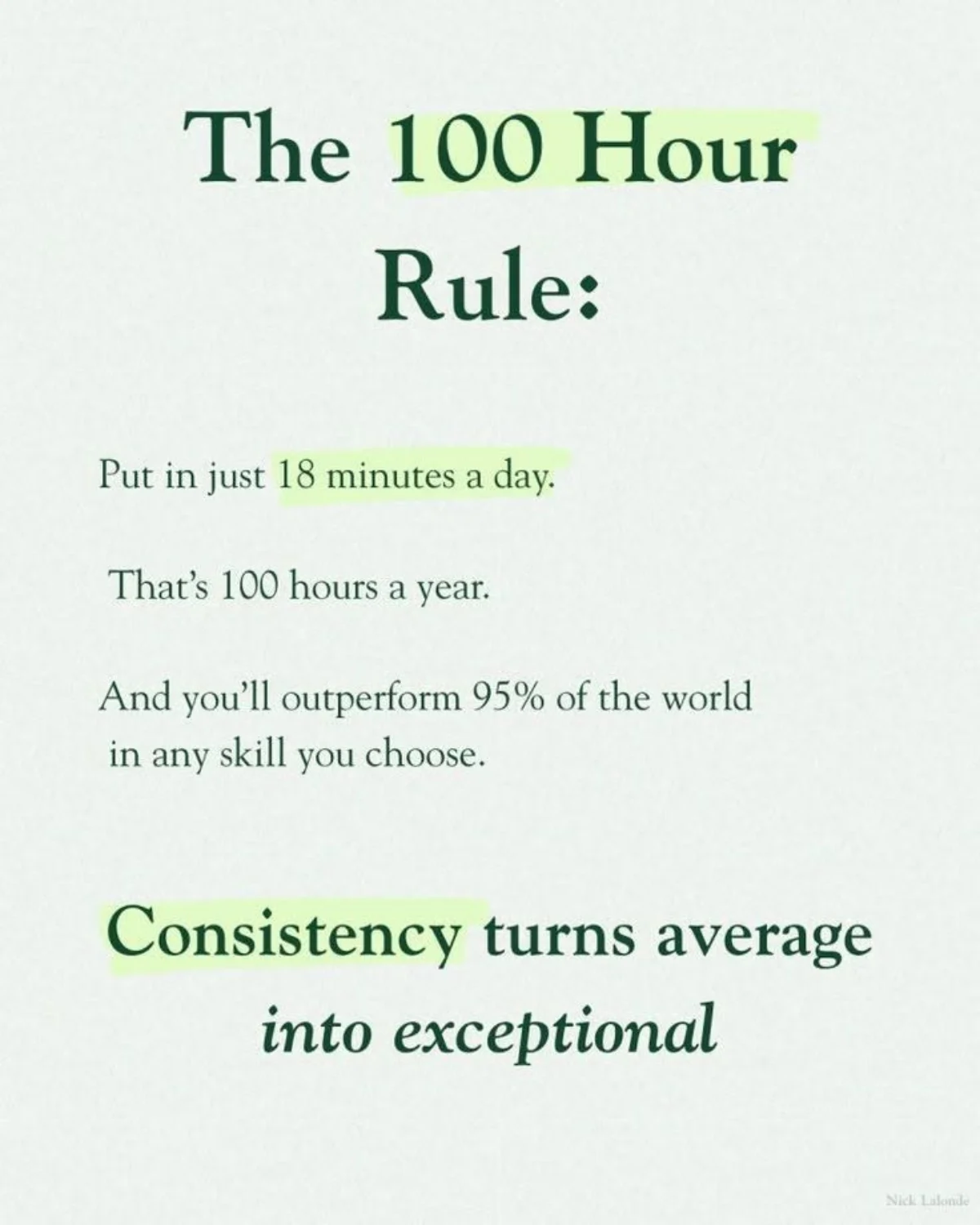
Expertise rarely arrives in a lightning bolt. More often it accumulates quietly, one hour at a time, until you wake up and find you are simply better than you were three months ago. The 100-hour consistency rule describes this exact phenomenon: choosing a single focused skill, showing up with realistic repetition, and letting the compounding effect of steady hours do what scattered intensity cannot. It is not a shortcut. It is a profoundly reliable pattern that takes the drama out of growth and replaces it with quiet, undeniable improvement.
When people talk about the 10,000-hour rule, the number feels impossibly distant. But one hundred hours sits right at the edge of reachable. That is two hours a week for a year, or a little under two hours a day for two months. The magic is not the total. The magic is the decision to stop starting and restarting. With a hundred hours of focused consistency, the beginner fog lifts completely. You no longer wonder what to do next; you start to feel why a technique works, not just how to copy it. Your hands, your voice, your brush, or your code editor begins to cooperate without the mental friction that marked the early attempts.
What 100 Hours Really Feels Like
It helps to name the early phases so you do not mistake normal discomfort for failure. The first ten to fifteen hours feel clumsy. Nothing flows, you forget what you learned yesterday, and your output looks far worse than your taste wants it to be. That gap between taste and ability aches, but it is a sign your perception is sharp. Pushing through those first fifteen hours without skipping long stretches is the hardest door to unlock.
By hour thirty, something small but meaningful shifts. You recognize patterns without thinking, you need fewer tutorials, and you start correcting your own mistakes on the fly. The work still looks amateurish, but it no longer feels entirely foreign. You stop asking “am I doing this right” and begin asking “what happens if I try it this way.” That curiosity is the first stripe of genuine ownership. From hour fifty onward comes what many describe as a quiet fluency: not mastery, but the ability to produce a reliable result on a reliable timeline without emotional exhaustion. The final stretch between hour seventy and one hundred polishes those instincts into a baseline of real competence. At that point, skill is no longer borrowed from a teacher or a video; it lives inside you.
Why Consistent Hours Beat Bursts of Effort
The brain consolidates learning during rest, not during the act itself. A long binge on Saturday followed by six empty days gives your neural pathways one chance to fire together and then a week to lose that fragile connection. Daily or near-daily short sessions send a repeated signal that says “this matters, keep building.” Sleep, in particular, acts as the glue. Without sleep after practice, retention drops sharply. Regular short practice plus regular sleep forms a biological rhythm that spaced-overload schedules simply miss.
There is also an emotional reason consistency wins. Large sporadic efforts come with large expectations. When you cram five hours into one afternoon and do not see instant transformation, it is demoralizing. Small consistent hours, on the other hand, feel modest enough that improvement surprises you. You glance back at an entry from three weeks ago and notice the difference without having aimed at it directly. That gentle feedback loop protects motivation far longer than the emotional peaks and valleys of infrequent binges.
The Human Skills That Deepen During 100‑Hour Consistency
It is easy to picture this rule only for visible crafts: learning guitar, watercolor painting, baking bread, or picking up a new sport. But the rule applies just as strongly to softer, deeply human abilities that shape how you move through the world. Active listening, for example, takes hundreds of tiny corrections: noticing when you interrupt, learning to ask a follow-up question that proves you heard the emotional subtext, and sitting with silence instead of rushing to fill it. One hundred hours of mindful conversational practice with a consistent partner or group changes relationships measurably.
The same holds for emotional regulation, journaling, cooking without recipes, or garden observation. These are not talents you drill; they are sensitivities you sharpen through repeated calm exposure. In each case, consistency is the solvent that dissolves the performance anxiety. When you know you will try again tomorrow, today’s imperfect attempt loses its sting.
Practical Ways to Structure the 100 Hours Without Burning Out
One hundred hours sounds manageable until life crowds in. The people who reach it cleanly do not rely on motivation; they rely on a container that feels unremarkable enough to stick. The following gentle structure helps protect the buildup without turning the practice into another exhausting to-do item.
- Pick one skill and name it plainly. “Learn guitar” is too broad. “Play through five beginner songs with clean chord changes” gives the hours a clear end point.
- Decide on a minimum daily dose. Twenty minutes is plenty. On overflowing days, you still do the twenty. On spacious days, you might stretch to forty-five, but you never skip.
- Keep a visible tally. A simple notebook, a wall calendar with checkmarks, or a note on your phone. Watching the count climb becomes a reward in itself when the results are still quiet.
- Anchor practice to an existing routine. Right after your morning coffee, right before you brush your teeth at night, or during the baby’s first nap. The cue is more reliable than a time on the clock.
- Plan a twenty‑five hour review. At the quarter mark, step back and check what feels different. Adjust your approach based on what is working, not on what you guiltily assume you should push harder on.
- Protect the rest days gently. If you choose to practice five days a week instead of seven, let the off days be true recovery. No guilt-scrolling other people’s progress.
What Consistency Does That Intensity Cannot
Intensity sharpens. Consistency seasons. Both have value, but they serve different stages of growth. An intensive weekend workshop can blow open a stuck door and show you what is possible. What it rarely does is build the daily neural scaffolding that turns that glimpse into a permanent part of you. The 100-hour consistency rule operates like slow-drip irrigation soaking down to the roots rather than a flash flood that runs off the surface. After one hundred steady hours, you own the skill in your bones. After a few intense weekends, you often own only the memory of a good weekend.
There is also a social and identity layer. When a practice becomes part of your normal rhythm, you start to see yourself as someone who does the thing. That identity shift is the engine that carries you past the point where novelty dies and real work begins. Identity formed through consistency feels sturdy and personal. Identity formed through occasional heroic effort often collapses under the guilt of not maintaining it.
Recognizing the Quiet Milestones
Because the 100-hour consistency rule generates gradual change, external feedback can lag weeks behind internal growth. It is useful to measure what is actually shifting rather than waiting for applause or likes. Early milestones to watch for include a noticeable reduction in setup friction: you no longer procrastinate pulling out the supplies or opening the file. You begin to solve problems without reaching for a tutorial. You produce something that is not flawless but is undeniably yours, carrying a style or decision you made consciously. You catch your own mistake before anyone points it out.
Most tellingly, you start to miss the practice when life briefly interrupts it. Not because you are punishing yourself, but because the act itself has become a small anchor in your day. That feeling is the strongest indicator that the identity shift has already happened. Hours seventy through one hundred serve less to teach new mechanics and more to deepen that reliable inner rhythm.
Common Questions About the 100‑Hour Consistency Rule
Do I need to practice the same exact activity every day?
Not exactly the same drill, but the skill should stay within a focused domain. If your goal is drawing portraits, spending some sessions on shading, some on proportions, and some on quick sketches still counts because everything feeds the same core ability. What dampens progress is switching domains entirely: two weeks of drawing, then a month of piano, then back to drawing. The brain needs repeated, adjacent signals to form the right networks. Variation within the skill is healthy and prevents staleness; hopping across unrelated skills resets the accumulation clock more than people realize.
What if I miss several days or a week?
Missing a week is not a reset button on the hours you already invested. The neural pathways are weakened but not deleted. The important move is to restart gently with the minimum dose rather than cramming to “catch up.” Cramming introduces fatigue and sloppy form, which then demands extra hours to unlearn. Pick up exactly where your routine left off, give yourself two or three sessions to regain the feeling, and continue forward. The tally pauses, not disappears. Over a long arc, even a few pauses barely register if you return with patience.
How do I stay patient when progress feels invisible?
Keep a simple record that captures not just the hours but the subjective feel. A single sentence after each session works wonders: “Felt choppy, couldn’t get the transition clean” or “Today the wrist finally relaxed on its own.” Over twenty or thirty entries, you will see a clear narrative arc that your day-to-day mood distorts. You can also keep one early clumsy sample handy. Comparing your current output to that rough first attempt every two weeks provides undeniable proof that silent progress is accumulating. The data quiets the impatience better than a pep talk can.
Is one hundred hours enough to become “good” at anything?
Good is a subjective word, but one hundred consistent hours reliably produces functional competence. At a hundred hours of bread baking, you can produce a beautiful loaf without holding your breath. At a hundred hours of a new language, you can order food, navigate directions, and have a warm but simple conversation. At a hundred hours of yoga, you know the postures, you understand your body’s signals, and you have likely developed a personal practice rhythm. It is not mastery, but it is the exact point where the activity stops feeling like a struggle and starts feeling like a genuine part of your life. That shift is far more valuable than chasing perfection.
One hundred hours of consistency gives you something few people expect: it hands you the quiet authority that comes from having shown up long enough to know the terrain. Not from a book, not from a course description, but from your own repeated observation. The skill is not just in your head anymore; it lives in your hands, your ears, your timing, and your confidence. The rule does not demand extraordinary talent or heroic discipline. It simply asks you to give a small, regular part of your week to something that matters to you and trust that the math of steady effort is on your side. It always is.