
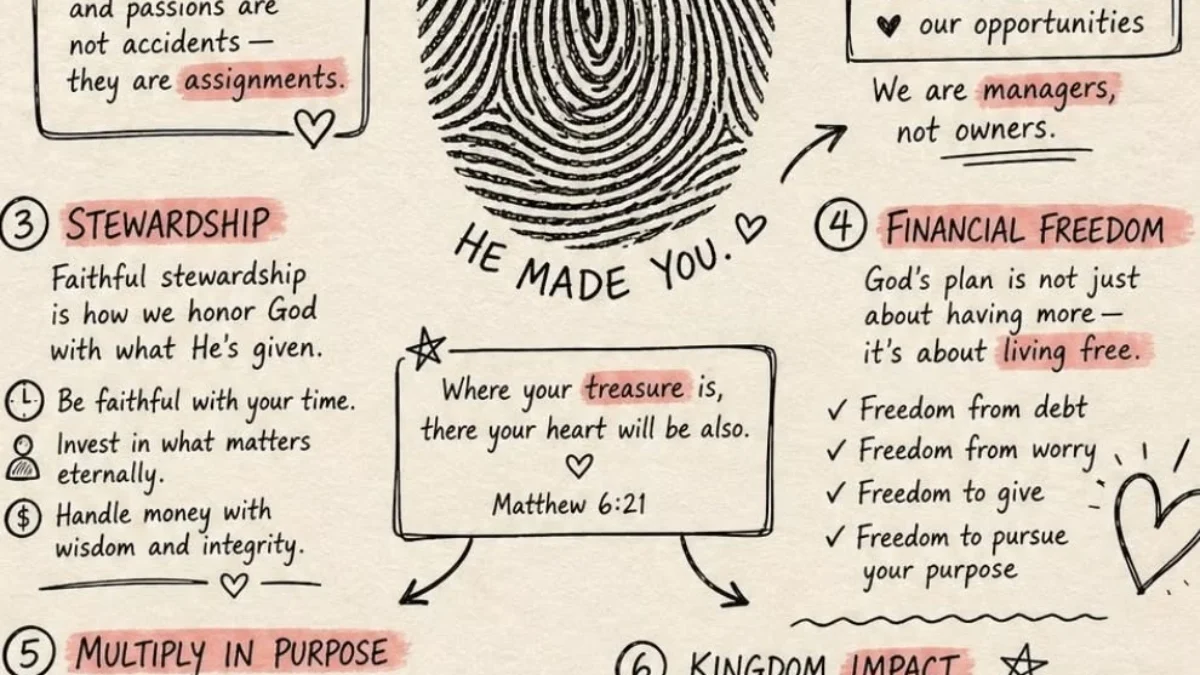
Many of us go through life separating our spiritual walk from our bank account. Sunday belongs to faith, and Monday belongs to the budget. The idea of God’s financial plan for your life challenges that division head-on. It suggests that your finances are not a secular side note but a core part of how you express your faith and discover your purpose. The visual guide we are exploring today puts a profound truth at the center: “He Made You.” This isn’t a lesson in getting rich quickly; it’s an invitation to view your money through the lens of a unique design, a divine ownership, and an eternal purpose that promises freedom, not stress.
Why Understanding God’s Financial Plan Matters
If you have ever felt restless about money, you know that focusing purely on numbers rarely brings peace. A spreadsheet can show you what you have, but it cannot tell you why you have it. The six principles we are looking at shift the focus from a scarcity mindset to an identity-centric one. The visual guide starts not with a rule, but with a relationship. It places your identity as a chosen individual in the middle of a financial framework. This matters because when your financial decisions flow from knowing you are intentionally created, the daily grind of earning and saving gains a higher meaning. You stop asking just what you can afford and start asking what you are built to do.
This perspective also addresses burnout. Trying to keep up with economic trends or the lifestyle of neighbors is exhausting. When you see your value as inherent rather than purchased, the pressure to prove yourself through possessions lifts. The illustration notes that “God’s plan is not just about having more — it’s about living free.” That statement defines the heart of the matter. It redefines wealth as a state of the soul and a posture of stewardship, rather than a balance in a digital ledger.
God’s Financial Plan for Your Life: The Core Principles
The image we are examining outlines a holistic approach to money that is deeply personal. It is not a one-size-fits-all investment guide but a set of foundational truths. These six segments act as a compass, orienting your heart before you ever open a savings account or pay a bill.
1. You Are Chosen and Uniquely Made
The graphic centers on a human fingerprint, a symbol that you are entirely distinct. The text reinforces this with the phrase, “You are not random. You are chosen.” This is the starting line for financial wisdom. If you believe you are an accident, your spending will likely aim at creating a temporary sense of security or identity. But if you recognize a purposeful design, you can start directing your resources toward the specific work and legacy you were designed for. Your financial plan should match your fingerprint, not the blurred-out lifestyle of the masses.
2. God Owns It All
One of the most countercultural ideas in the guide is the simple statement, “He owns it all.” In a world that prizes ownership, this principle radically alters your stress levels. If you are the ultimate owner, every loss is a catastrophe and every gain is solely for your consumption. But if you are a caretaker of God’s property, you can hold your possessions loosely. This isn’t a denial of legal ownership; it’s a heart posture that recognizes you are a temporary manager. Viewing your paycheck as entrusted resources rather than private loot changes how you spend, save, and give.
3. Faithful Stewardship
The guide defines this clearly: “Faithful stewardship is how we honor God with what He’s given.” Stewardship is not code for a church donation. It is a comprehensive management style. It affects how you treat a paycheck, a bonus, a debt, or an unexpected windfall. The small icons in this section suggest careful handling, growth, and protection. A steward asks whether a purchase supports the owner’s mission. A steward avoids waste not because of a law against spending, but because they value the One they represent. This is a call to excellence in budgeting, working, and investing.
4. Living in Financial Freedom
Freedom in this context does not mean a fantasy where you never have to work or eat at expensive restaurants every night. The image highlights that God’s design is about “living free.” True financial freedom is the ability to say yes to God’s call and no to a culture of debt. It is the capacity to be generous at a moment’s notice because you are not enslaved to a lender. This often requires living below your means, not as a punishment, but as a strategic choice to maintain your mobility and peace.
5. Multiplying in Purpose
The visual’s fifth segment links spiritual reality with daily commerce: “Your finances are spiritual. Honor God, impact the world.” Money is a tool for multiplication. It can multiply solutions for the hurting or resources for the spreading of hope. When your identity is secure, you no longer need to hoard. You can start multiplying. This could mean using your capital to create jobs that honor human dignity, funding a cause that aligns with your values, or simply having the margin to help a neighbor in crisis without hesitation.
6. Kingdom Impact Over Self
The final piece humbles us: “It’s not about you. It’s always been about His kingdom.” This protects us from treating God like a cosmic financial advisor who exists to build our personal empires. The kingdom focus shifts your portfolio from a monument to your own success into a supply line for eternal work. It helps you ask a hard and freeing question: When I am gone, did my money merely make me comfortable, or did it echo into a story much larger than my own life?
Practical Considerations When Applying These Principles
You might look at these six ideals and wonder how they translate to a Monday morning with bills on the counter. The path from theory to practice requires honest assessment. You cannot strategize your stewardship if you don’t know what you are stewarding. A deep dive into your current income, debts, and spending patterns is a spiritual discipline, not a secular one. The practical step of creating a budget is an act of honoring the “faithful stewardship” principle. If God owns it all, we owe it to Him to have a clear, honest picture of where His resources are flowing.
There is also a relational dimension. Embracing a kingdom mindset about money can feel isolating if your family or social circle does not share it. You might face pressure to keep up with a certain standard of living. Practical application often means setting non-negotiable boundaries. It means unsubscribing from marketing emails that tempt you toward false identity purchases. It means finding community that genuinely cheers for your decision to pursue freedom over status, echoing the fingerprint principle that you are distinct and not required to mirror everyone else’s path.
Useful Tips to Align Your Money with Faith
Moving an abstract plan into real life takes small, consistent steps. The visual we studied breaks down complex theology into simple actions. Here are a few practical ways to align your wallet with your calling without getting overwhelmed.
- Start with identity, not math. Before you track expenses, write down the truth that you are not random. Let your budget categories reflect what the real you values, not what culture pressures you to buy.
- Conduct an “ownership audit.” Look at a recent bank statement and ask honestly whether you spent it as an owner or a steward. No guilt needed, just honest awareness.
- Create margin for impact. To multiply in purpose, you need unallocated money. Cut one recurring cost that contributes little to your genuine well-being and direct that toward a kingdom impact goal.
- Practice immediate generosity. Don’t wait for a giant surplus. Give something away today, even a modest amount, as a tangible way to break the grip of the “It’s all mine” illusion.
- Celebrate freedom, not stuff. When you avoid a foolish debt or pay one off, stop and mark the moment. Gratitude for freedom reinforces the behavior better than longing for what you don’t own.
FAQ: Navigating God’s Financial Plan
Does following God’s financial plan mean I will become wealthy?
The goal of this framework, as laid out in the illustration, is not a guarantee of material riches. It focuses on provision, stewardship, and freedom. The kind of wealth emphasized here is a rich purpose and a freedom from the anxiety of constant grasping. You may see financial increase as a result of disciplined stewardship, but the ultimate target is living free and making an impact, not simply having a bigger number on a statement.
How can I practice stewardship if I am currently in serious debt?
Stewardship begins right where you are, not where you wish you were. If you are in debt, start faithfully managing the income you have now, however small. Acknowledging that God still owns the resources you do control—even if the balance is negative—helps frame your repayment plan as an act of honoring obligations. It also means carefully avoiding new debt so that you can reposition yourself to be free to give and serve without chains.
What does it practically mean that “He owns it all” when I earned the money?
This principle speaks to the ultimate source of your ability. Yes, you worked the hours and applied your skills, but the fingerprint in the center of the image speaks to the origin of those talents. Seeing God as the ultimate owner changes how tightly you grip your possessions. It means that when a need arises that you can meet, you can release funds without a sense of catastrophic loss because you are simply moving resources within the owner’s household.
Is it selfish to enjoy nice things under this plan?
The issue is less about the object and more about the dependence. The principle is about not seeking identity in possessions. The guide says you are already chosen and uniquely made, so your dignity does not rise or fall with your car or house. Enjoying something beautiful or fun is not contradictory to a life of purpose as long as it does not prevent you from faithful stewardship and generous impact. If your enjoyment leads to gratefulness rather than pride, it can be a healthy part of your life.
How do I know which specific “kingdom impact” to support?
Look back at the fingerprint. Because you are uniquely designed, you will likely have a unique burden. Pay attention to the needs that genuinely stir your heart, whether they are local or global. Start by looking for ways to meet needs right in front of you before searching for grand projects. You are the best steward of your resources when you direct them toward burdens you understand and can meaningfully support with consistency and prayerfulness.
Moving Forward with Purpose and Peace
Reorienting your financial habits around these six principles is a gradual journey, not an overnight overhaul. You will likely have days when you forget that you are a steward and slip back into owner-mode, clutching what you have or obsessing over what you lack. That’s part of the process. The gift of a plan centered on God’s perspective is that grace covers those steps backward. You can start fresh tomorrow with the truth that you are made with a fingerprint all your own, tasked with a freedom that doesn’t expire with market downturns. Use your finances to tell a story that goes far beyond a bank balance, and you will find the very freedom your heart has been seeking all along.