Table of Contents
- Does Grandma’s Mop Water Trick Really Work?
- What Each Ingredient Actually Does
- A Safer 5-Step Mop Water Method
- Can You Still Use Lemon Peels and Mint?
- Why Baking Soda and Vinegar Work Better Separately
- Which Mop Water Should You Use for Each Floor?
- Common Mop Water Mistakes
- Frequently Asked Questions
- Sources
The viral Grandma’s mop water trick combines warm water, lemon, baking soda, vinegar, and mint for fresher-smelling floors. Some parts of the idea are useful, but mixing everything together is not the safest or most effective choice for every type of floor.
- Best for: Routine cleaning of compatible hard floors
- Time: About 15 to 30 minutes
- Difficulty: Easy
- Main rule: Match the cleaner to your floor type
- Avoid: Using vinegar on hardwood or natural stone
Does Grandma’s Mop Water Trick Really Work?
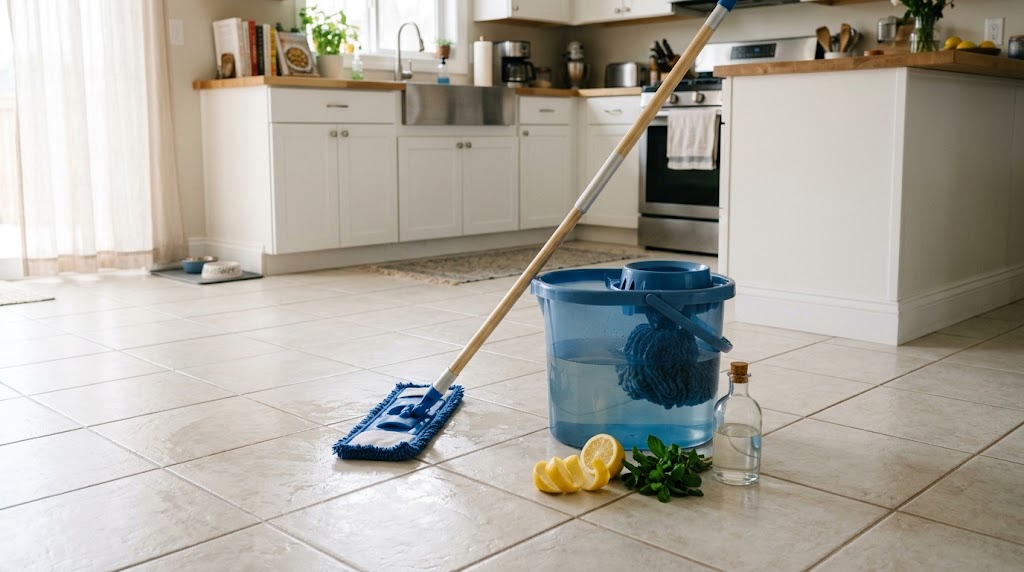
Parts of the old-fashioned method can help with everyday cleaning. Warm water loosens normal dirt. Vinegar can help with mineral residue and grime on surfaces that tolerate acid. Baking soda can help with some odors and stubborn spots when used separately.
The main problem is putting every ingredient into one bucket and treating the mixture as a universal floor cleaner.
Vinegar is acidic, while baking soda is alkaline. When they meet, they fizz and begin to neutralize each other. The bubbling looks powerful, but it does not mean the final mop water cleans better.
Lemon peel and mint are mainly useful for scent. A few pieces in mop water should not be treated as a reliable disinfectant.
What Each Ingredient Actually Does
| Ingredient | What It Can Do | Better Use |
|---|---|---|
| Warm water | Loosens everyday dirt | Use as the base |
| Lemon peel | Adds a citrus scent | Optional, then strain |
| Baking soda | Helps with some odors and spots | Use separately when needed |
| White vinegar | Helps remove some mineral residue | Only on compatible surfaces |
| Mint leaves | Add a fresh scent | Optional, then remove |
Tip: More ingredients do not automatically create a better floor cleaner. A simple mixture that matches the floor is easier to use and less likely to leave residue.
A Safer 5-Step Mop Water Method
Check your floor type first.
Find out whether the surface is ceramic tile, porcelain, vinyl, laminate, hardwood, or natural stone. Cleaning products that work on one surface may damage another.
Sweep or vacuum before mopping.
Remove crumbs, hair, dust, and grit. Wetting loose dirt can turn it into muddy residue and make the floor harder to clean.
Fill the bucket with warm water.
Warm water is enough for many light cleaning jobs. Very hot or boiling water is unnecessary and may not be suitable for some floor finishes.
Add only a cleaner that suits the surface.
For compatible ceramic tile, diluted white vinegar may be useful for periodic cleaning. Skip vinegar on hardwood and acid-sensitive stone.
Wring the mop well.
The mop should be damp instead of dripping. Work in small sections and change the water when it becomes visibly dirty.
Can You Still Use Lemon Peels and Mint?
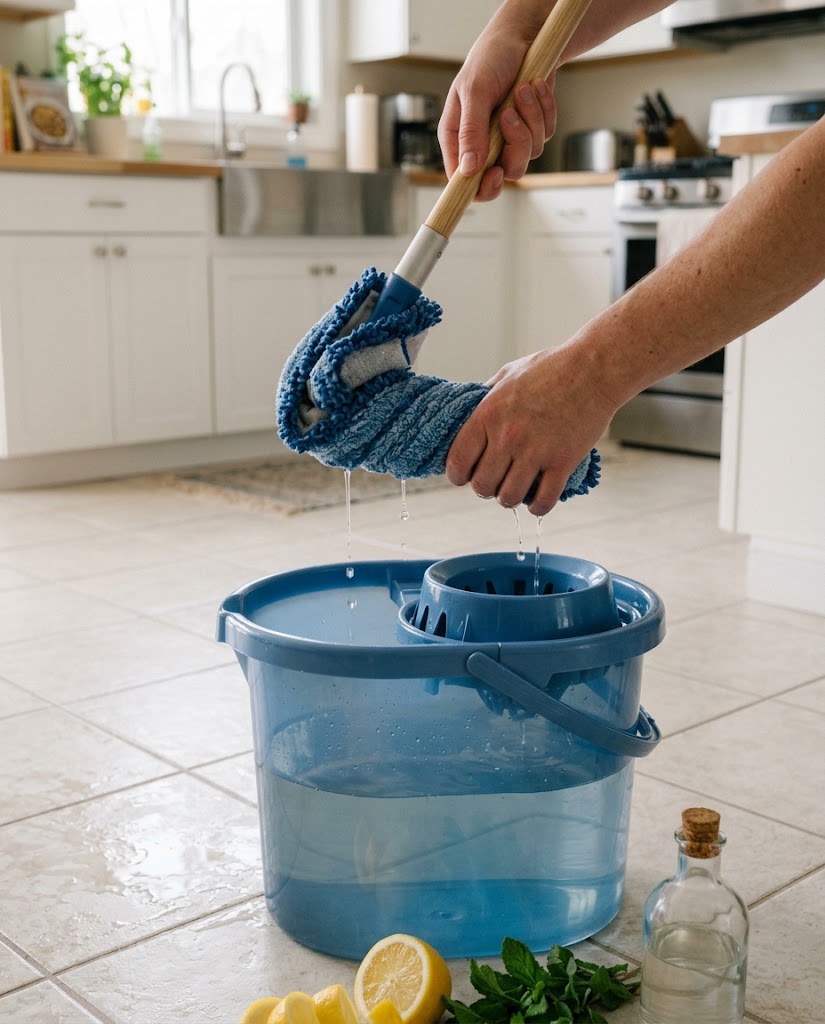
Yes, if you only want a mild fresh scent. Place a few clean lemon peels or mint leaves in warm water for a short time, then remove them before mopping.
Straining the water matters. Small pieces of peel, pulp, or leaves can stick to the mop or end up back on the floor.
Do not depend on lemon peel or mint as a disinfectant. Fresh smell and disinfection are different things.
Lemon is also acidic, so avoid lemon juice and strong citrus mixtures on marble and other acid-sensitive natural stone.
Why Baking Soda and Vinegar Work Better Separately
Baking soda and vinegar can both be useful around the home, but they do different jobs.
Baking soda is alkaline. Vinegar is acidic. Combining them starts a chemical reaction that produces the familiar bubbles while reducing the properties that made each ingredient useful on its own.
A better method is to choose one product for the job instead of adding both to the mop bucket.
For example, baking soda mixed with a little water can form a paste for certain stubborn spots or unsealed grout. Rinse it away afterward so powder does not remain on the floor.
Which Mop Water Should You Use for Each Floor?
Ceramic and Porcelain Tile
Warm water is a good starting point for normal cleaning. If the manufacturer allows acidic cleaners, diluted vinegar can be useful for occasional mineral buildup or grime.
Always test a small hidden area first if you are unsure about the finish.
Hardwood Floors
Skip the viral vinegar mixture.
The National Wood Flooring Association advises following the flooring or finish manufacturer’s cleaning instructions and avoiding excessive moisture. Vinegar can damage or dull some wood floor finishes.
Use a cleaner made for your specific wood finish and keep the mop only lightly damp.
Natural Stone
Do not use vinegar or lemon juice on marble, limestone, travertine, or other acid-sensitive stone.
Acid can react with the stone and leave dull or etched areas. A pH-neutral cleaner designed for natural stone is the safer choice.
Laminate Flooring
Use as little moisture as possible and follow the floor manufacturer’s care instructions. Water can enter seams if the mop is too wet.
Do not assume that a homemade vinegar mixture is suitable for every laminate finish.
Vinyl Flooring
Many vinyl floors are easy to clean, but formulations and protective layers vary. Check the manufacturer’s directions before using homemade acidic solutions.
Common Mop Water Mistakes
- Adding too much cleaner: It can leave a sticky or cloudy film.
- Using a soaking wet mop: Water can collect in seams and around floor edges.
- Skipping sweeping: Dirt and grit get dragged through the wet floor.
- Using vinegar on every surface: Acid is not safe for all finishes.
- Leaving lemon or mint pieces in the bucket: Plant material can end up on the floor or trapped in the mop.
- Assuming fresh smell means disinfected: Fragrance does not prove that germs were killed.
Safety: Never mix bleach with vinegar, lemon juice, ammonia, or other household cleaners unless the product label specifically says the combination is safe. Dangerous gases can form when incompatible cleaning chemicals are mixed.
Frequently Asked Questions
Can I put baking soda and vinegar in mop water together?
It is better to use them separately. They react with each other, and too much baking soda can also leave a powdery film on some floors.
Can I use this mop water on hardwood?
Do not use the full viral mixture on hardwood. Use the cleaner recommended for your particular floor finish and keep moisture to a minimum.
Can I mop marble with vinegar?
No. Vinegar and lemon juice are acidic and can damage marble and several other types of natural stone.
Does mint make mop water antibacterial?
A few mint leaves may make the water smell fresh, but they should not be treated as a dependable disinfectant.
Why does my floor feel sticky after mopping?
Sticky floors are often caused by using too much cleaner, leaving soap residue behind, or continuing to mop with dirty water. Use less product and change the water when it becomes cloudy.
Sources
For floor-specific cleaning and safety guidance, see University of Florida IFAS Extension and the National Wood Flooring Association.