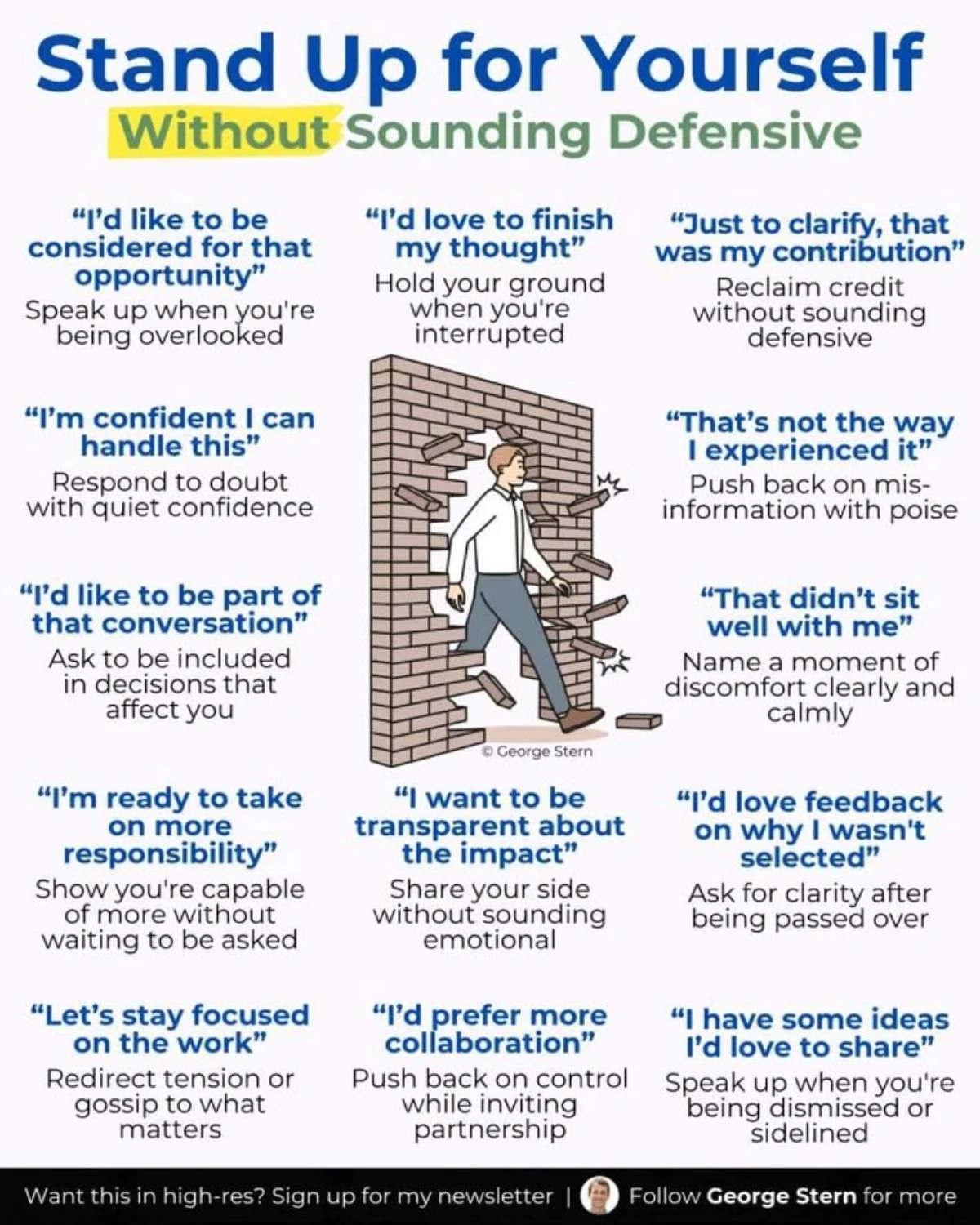
There is a quiet kind of power that comes from knowing exactly what to say when someone crosses a line. It is not about raising your voice, memorizing snappy comebacks, or armoring up for a fight. Standing up for yourself without sounding defensive is a skill built on clarity, self-respect, and a steady tone. The right phrases can help you protect your time, your energy, and your emotional well-being while keeping the conversation productive and your relationships intact.
Why the Right Phrasing Matters
The word choices we make when we feel cornered determine how our message lands. When adrenaline spikes, it is easy to slip into explanations, apologies, or even subtle accusations that make us look unsure or guilty. Defensive phrases often start with over-explaining, such as listing every reason you are not available instead of simply saying you cannot make it. Defensive language signals to the other person that they have something to push against, and it can actually weaken your position.
Calm, firm language does something different. It communicates that your stance is not up for negotiation, yet it leaves the door open for mutual respect. This is not about being cold or distant. It is about honoring your needs without accidentally inviting a debate about whether your feelings or limits are valid. When you choose phrases that are clear and uncharged, you hold your ground without building a fortress around yourself.
People often mistake assertiveness for aggression, especially if they grew up in environments where speaking up was penalized. Standing up for yourself is actually an act of self-care. It reduces resentment, prevents burnout, and teaches others how to treat you. The goal is not to win an argument but to honor your own worth while staying present and respectful.
Phrases to Use When You Need to Set a Gentle Limit
Boundary-setting does not require a dramatic confrontation. In fact, the most effective boundaries are often set in a quiet moment with simple words. The key is to state your limit directly, without padding it with justifications that give the other person a foothold to argue. When you say less, you often communicate more strength.
Keep your voice even and your body language open. You do not need to furrow your brow or cross your arms to prove your seriousness. A soft tone paired with a firm message is disarming in the best way. The phrases below can be adapted to fit your natural speaking style and the specific relationship at hand.
- “I can’t take that on right now.”
- “That doesn’t work for me.”
- “I’m not comfortable with that.”
- “I need some time to think about this.”
- “I’ll pass on that, but thank you for thinking of me.”
- “I’m going to sit this one out.”
- “I’m not available for that kind of conversation.”
Notice that none of these phrases begin with “sorry” or end with a lengthy justification. While an apology has its place when you have genuinely caused harm, overusing it when setting a boundary muddles your message. You can be polite and kind without hollowing out your own request. A warm smile paired with a clear “I can’t” often feels more respectful than a rambling excuse that makes everyone uncomfortable.
Responding to Unsolicited Advice or Criticism
Unsolicited opinions can sting, especially when they touch on sensitive areas like parenting, career choices, or personal appearance. The instinct to defend yourself can be overwhelming. You feel a rush to explain your reasoning, perhaps to prove you have not made a mistake. Yet a defensive reaction often fuels more unwanted advice, turning a passing comment into a lengthy debate.
Acknowledgment is not agreement. You can thank someone for their perspective without adopting it as your own. This approach keeps the exchange brief and protects your peace. You are not shutting down communication; you are simply refusing to get tangled in a conversation that serves no one.
- “I appreciate your perspective, but I’m happy with how I’m handling it.”
- “Thanks, I’ve got this covered.”
- “I hear you, and I’m going to do it my way this time.”
- “That’s an interesting take. I’m not looking for feedback right now though.”
- “Thanks for your concern. I’m comfortable with my choice.”
If the other person persists, it is perfectly acceptable to repeat your chosen phrase calmly. Consistency conveys resolve. You do not need a new argument each time. A simple “I hear you, and I’m still comfortable with my decision” closes the loop gracefully.
Addressing Interruptions and Being Talked Over
Few things feel more dismissive than being interrupted mid-sentence. It sends a signal that your words are less valuable, and it can spike your heart rate in a flash. Reacting with visible irritation, however, can escalate the situation and make you appear rattled. A poised response reclaims your space without creating a spectacle.
Body language plays a huge supporting role here. Holding up a gentle hand, maintaining eye contact, or simply continuing to speak calmly can reinforce your words. You are not demanding the floor; you are gracefully holding onto it. The goal is to advocate for your voice while preserving the dignity of everyone at the table.
- “Let me finish this thought, and then I’d love your input.”
- “I’m almost done. Just a moment.”
- “I want to make sure I get this out clearly before I lose my train of thought.”
- “Hold on, let me wrap this up.”
- “I’ll get to your point in just a second. I want to finish mine first.”
Turning Down Requests Without Guilt
Saying no is a practice, not a personality trait. Many of us have been taught that being agreeable is a virtue, and of course kindness matters. But a life lived without honest refusals leads quickly to exhaustion and quiet resentment. The people who truly care about you will survive your no. In fact, they may respect you more for your honesty.
A guilt-free refusal does not attack the request or the person making it. It simply clarifies what you can and cannot give right now. You do not owe a list of prior commitments. A warm, simple statement is often enough, and it leaves far less residue than a fabricated excuse that you later have to maintain.
- “I’m not able to commit to that.”
- “My plate is full right now.”
- “I won’t be able to give that the attention it deserves, so I’ll have to decline.”
- “That’s not something I can help with this time.”
- “I’m saying no for now, but thank you for asking.”
Stand Up For Yourself Phrases Without Sounding Defensive in Heated Situations
Heated moments require a different kind of steadiness. When emotions are high and voices are strained, a defensive reply can turn a disagreement into a lasting wound. These are the moments a single phrase can de-escalate tension while still holding your truth firmly in place. You are not backing down; you are simply refusing to mirror the heat.
Buying time is a legitimate and wise strategy. You do not have to answer on the spot. Pausing to collect your thoughts conveys self-possession, not weakness. Speaking slowly and deliberately invites the other person to dial down their own intensity.
- “I need a moment to collect my thoughts before I respond.”
- “I can see this matters to you. I still feel differently, and that’s okay.”
- “I’m not going to engage in a back-and-forth right now. Let’s talk when we’re both calmer.”
- “I understand you’re upset. I still stand by what I said.”
- “I’m not comfortable with how this is going. Let’s take a break and circle back.”
Frequently Asked Questions
What is the difference between being assertive and sounding defensive?
Assertiveness comes from a grounded place of self-respect and clarity. It sounds calm, direct, and unapologetic without being harsh. Defensiveness carries a charge of anxiety or fear. It often involves over-explaining, a trembling voice, a hurried pace, or subtle justifications that seek approval. An assertive person states their boundary and stops talking. A defensive person tries to manage the other person’s emotional reaction to that boundary.
How can I stand up for myself if I am naturally shy or introverted?
Start small and practice in low-stakes situations. Use written communication, like email or text, to build confidence in phrasing your boundaries clearly. Rehearse a few go-to phrases aloud when you are alone so the words feel familiar. Remember that standing up for yourself does not require a loud personality. Quiet, brief statements delivered with calm eye contact can be immensely powerful. The volume of your voice matters far less than the clarity of your words.
What if someone reacts badly to my boundary?
Another person’s reaction to your boundary is not your responsibility to fix. If someone becomes angry, guilt-tripping, or dismissive, that response often reveals more about their discomfort with limits than about the validity of your request. Stay consistent, avoid over-explaining, and give them space to process. A healthy relationship will eventually adjust. If the pattern of negative reactions continues, it may be a sign that the relationship dynamic needs a deeper evaluation.
Should I apologize when I say no?
It is rarely helpful to apologize for respecting your own limits. A reflexive “sorry” can undermine a perfectly reasonable refusal and make you feel smaller. Save apologies for moments when you have actually made a mistake or caused unintended harm. For everyday boundary-setting, warm but unapologetic language serves you far better. Phrases like “I appreciate you asking” or “thank you for thinking of me” honor the request without implying you have done something wrong.
How can I use body language to support my words?
Body language anchors your verbal message. Stand or sit up straight, keep your shoulders back, and make gentle but steady eye contact. Avoid fidgeting, crossing your arms protectively, or looking at the floor. Speak at a measured pace and breathe evenly. An open, relaxed posture signals that you are comfortable with your position and not bracing for an attack. This physical confidence often helps your words land more effectively.
Carrying These Phrases Into Daily Life
Like any skill worth having, standing up for yourself without sounding defensive grows stronger with practice. Some days you will speak your phrase perfectly and feel a surge of quiet pride. Other days you might fumble, over-explain, or say nothing at all and later wish you had spoken. That is part of being human, and it is not failure. It is learning.
Give yourself permission to start where you are. Choose one or two phrases from this list that feel natural to you and keep them in your back pocket for the moments that count. You deserve to take up space with your words, to own your no and your pause without apology. The world will adjust, and you will walk through your days with a little more peace in your chest.