
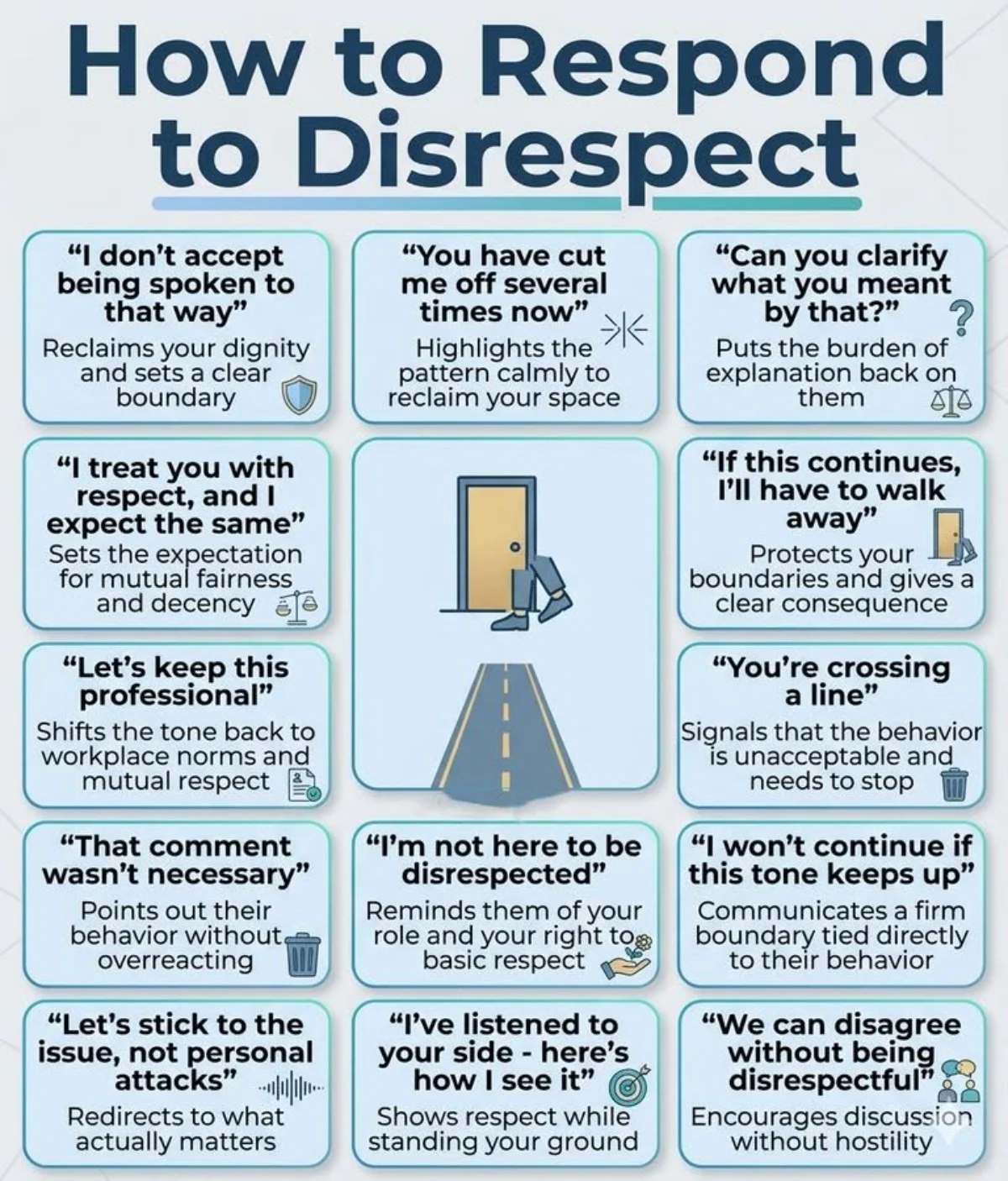
Everyone knows the sting of a condescending comment or the burn of being cut off mid-sentence. It arrives without warning, often wrapped in a polite smile or a casual laugh, and it instantly activates something deep inside you. In these moments, the brain often defaults to fight, flight, or freeze, leaving you replaying the scene hours later with a list of brilliant comebacks you wish you had delivered. Learning to navigate disrespect is less about mastering razor-sharp retorts and more about reclaiming your own calm. The goal is not to win a verbal battle but to walk away with your self-respect fully intact.
Why It Matters to Hold Your Ground Quietly
When someone dismisses your feelings or belittles your ideas, the instinct to defend yourself immediately can feel overwhelming. However, knee-jerk reactions often escalate tension rather than resolve it. Disrespect rarely comes from a place of logic; it usually stems from the other person’s insecurity, need for control, or emotional clumsiness. By shifting your focus from proving them wrong to protecting your inner state, you refuse to let their negativity dictate your mood. This quiet steadiness is not passive silence born from fear. It is an active, deliberate choice to prioritize dignity over drama. Holding your ground quietly signals that you are not available for chaos, and that boundary alone is an immensely powerful statement.
Key Details of Composed Responses
A measured response contains several distinct layers that go far beyond the words you choose. Your tone, pace, and physical posture often communicate more loudly than the actual sentence you speak. A lowered voice and steady eye contact naturally slow down an aggressive rhythm, while squared shoulders convey self-assurance without confrontational posturing. The pause you take before answering is a tool of tremendous value, giving you time to override reactive impulses and decide whether the comment even deserves your energy. Internally, grounding yourself with a slow exhale disrupts the fight-or-flight cascade and brings your thinking brain back online. This marriage of external poise and internal regulation is what changes the entire dynamic of an uncomfortable exchange.
Practical Considerations for Different Situations
Disrespect shows up in a range of settings, and your response must flex naturally to fit the context. A public meeting with a colleague who takes credit for your work calls for a different approach than a family dinner where a relative makes a cutting remark about your life choices. In professional spaces, clear neutrality often works best, allowing you to address the behavior with factual language that leaves no opening for gossip or further hostility. In personal relationships, soft firmness preserves the connection while still drawing a visible line. You always retain the right to step away when a conversation turns toxic, because removing yourself from a harmful dynamic is a complete response all on its own.
- In the workplace: Use brief, factual corrections and pivot back to the shared goal without personalizing the attack.
- With a partner or close friend: Say how the comment landed on you using “I” language, which invites repair instead of blame.
- In social or group settings: Deploy a light but firm redirect that signals you noticed the dig without escalating the room’s tension.
- With strangers or online interactions: Recognize when no response is the strongest shield, as feeding anonymity with attention rarely leads anywhere good.
- During family gatherings: Set an expectation quietly and privately when possible, knowing old patterns can take time to shift.
Useful Tips for Staying Steady in the Moment
Building this skill takes practice, and small daily habits create a sturdy foundation for the moments that truly test you. The pause is your greatest ally, and you can rehearse it simply by counting two full seconds before responding in everyday conversations. That tiny gap teaches your nervous system that not every silence needs to be filled. Similarly, having a handful of neutral reset phrases ready can rescue you from going blank under pressure. Grounding techniques like pressing your feet into the floor or tracing the outline of your thumb with a finger offer subtle ways to anchor yourself when your heart starts to pound. None of these strategies requires perfection; they simply need repetition until steadiness begins to feel natural rather than forced.
- Take a slow, silent breath in through your nose and out through your mouth before a single word leaves your lips.
- Press your feet evenly into the ground and notice the physical sensation of stability while keeping your expression neutral.
- Use a brief clarifying phrase such as “Tell me more about what you mean by that” to shift the spotlight back onto their words.
- Keep your hands open and relaxed at your sides rather than crossed or fidgeting, as open palms signal calm confidence.
- Mentally label the emotion that arises—not to suppress it, but to create a small gap between feeling and reaction.
Responding to Disrespect Phrases and Actions With Clarity
A short collection of reliable phrases can act as a gentle guardrail when your mind draws a blank. The goal of these lines is never theatrical confrontation. They are bridges that communicate self-respect without adding fuel to an already smoldering situation. A simple “I’m not comfortable with that comment” uttered in a neutral tone states a boundary without accusation. Saying “I see that differently, and I’m okay with that” shuts down circular arguments that drain your energy. When someone interrupts you repeatedly, a calm “I’d like to finish my thought” reclaims space without hostility. The real power behind all these responses lives in the unwavering delivery, not in the cleverness of the wording. The same sentence spoken from a centered nervous system lands completely differently than one rushed out in a shaky voice.
What to Do After the Moment Passes
Walking away from a charged interaction often brings a confusing mix of residual adrenaline, self-doubt, and delayed anger. Processing what happened thoughtfully prevents that discomfort from festering into rumination. Acknowledging what you handled well is just as important as noting what might have gone differently, because self-compassion builds resilience far better than harsh self-criticism. Physical movement provides an effective release valve, allowing your body to complete the stress cycle that got interrupted during the encounter. Speaking with a trusted confidant about the experience can untangle the story, but be mindful to avoid repetitive venting that simply reheats the original wound. Writing down your thoughts privately often reveals patterns you missed in the heat of the moment, giving you valuable insight for the next difficult exchange.
FAQ
What if I get so angry that I can’t think of anything to say?
Anger floods the brain with chemicals that temporarily dampen access to rational thought and verbal fluency. At the first flicker of heat rising in your chest, direct your focus entirely to your breath rather than scrambling for words. A simple “I need a moment” or even an extended pause is a complete and dignified response. You are never obligated to fill the silence just because someone else created an awkward tension. With practice, people find that brief, wordless grounding reopens the thinking mind much faster than forcing a reply through clenched teeth.
Is it ever acceptable to just walk away without saying anything?
Absolutely. Leaving a hostile situation is not rudeness; it is boundary enforcement. When disrespect is severe, repetitive, or deliberately aimed at provoking you, your presence is a privilege, not an obligation. Calmly walking away communicates that the conversation cannot continue under current conditions, and it protects you from saying things in anger that you might regret later. You can always return to the topic once both parties have regained composure, but in some cases, the departure itself is the final statement.
How do I respond when disrespect is disguised as a joke?
The disguised insult dressed up as humor is one of the trickiest forms of disrespect to handle because it offers the speaker quick deniability. One effective path is to refuse to laugh along and simply let the comment hang in the air without emotional rescue. You can also respond with gentle curiosity by asking, “What did you mean by that?” which forces the person to either clarify their harmful intent or retreat. Either outcome returns control to you without escalating the exchange into an argument about intent. A quiet, unimpressed expression often speaks louder than any sharp comeback.
What is the difference between being disrespected and just being sensitive?
Distinguishing between a genuine slight and a subjective emotional reaction requires honest self-reflection. Disrespect carries an intent or effect that violates basic dignity, such as mockery, contempt, or deliberate disregard for your time and voice. Sensitivity, on the other hand, often involves a strong emotional response to words or actions that were not necessarily aimed at harming you. Over time, you can learn to notice the physical signals of each: disrespect tends to leave a jagged, demeaning residue, while simple sensitivity usually fades once you examine the context. Trusting your instincts matters, and if a pattern of dismissal persists, that is evidence worth honoring.
Can responding calmly actually change how people treat me long-term?
Consistency in calm, firm boundaries does gradually reshape the dynamics around you. People who rely on passive aggression or intimidation often do so because they expect a large emotional payoff. When you repeatedly deny them that payoff, their behavior often loses its function and fades. However, some individuals may escalate briefly as they test your new style of response, which is a normal part of relational rebalancing. Over time, you will likely notice deeper, more genuine respect from those worth keeping close and a natural distance forming with those who cannot adjust.
Facing disrespect without crumbling or exploding is a daily practice, not a one-time achievement. Some days you will speak with grounded clarity; other days you will say nothing and still replay the moment on the drive home. That is human, not failure. The crucial shift happens when you stop measuring your worth by how perfectly you handled one comment and start noticing how much faster you recover your peace. Protect your energy, hold your center, and trust that quiet dignity leaves a lasting impression that shouting never can.