
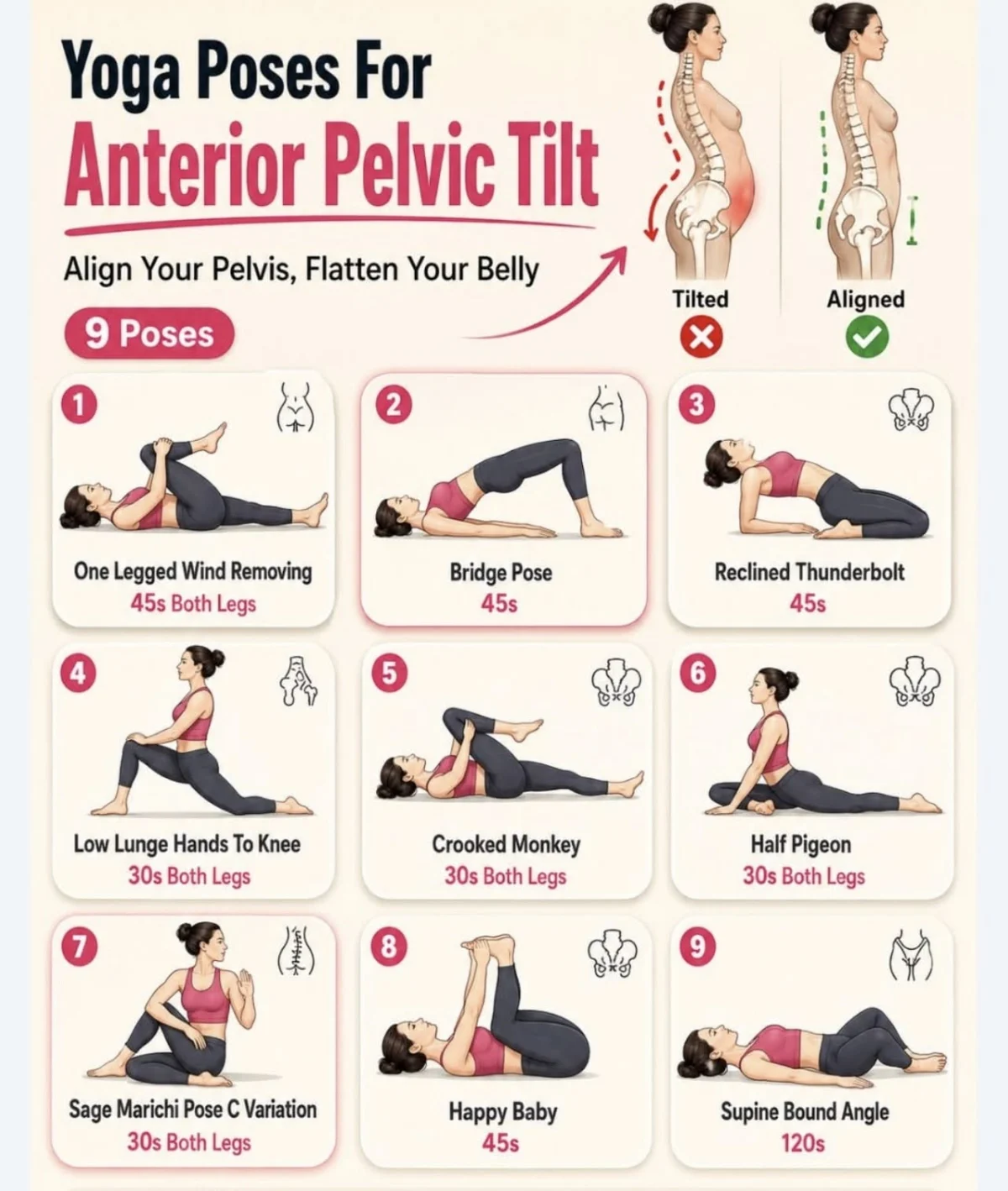
There is a quiet kind of discomfort that comes from standing with your tailbone tipped just a little too far back, your belly falling forward without you even noticing. It is a pattern many of us carry into yoga class, often without a name for it, and it is called anterior pelvic tilt. It can make your lower back feel tight and achy, leave your hips feeling perpetually clenched, and make standing on two feet surprisingly tiring. Yoga poses for anterior pelvic tilt offer a gentle route back toward a neutral, comfortable alignment—not through force or fear, but through a slow, attentive unwinding of muscles that have forgotten how to let go.
This is not about “fixing” something wrong with you. It is more like recalibrating a delicate instrument. Anterior pelvic tilt often comes from a familiar modern pattern: hip flexors that shorten from long hours in a chair, glutes that become a bit sleepy and underactive, and a lower back that takes on extra work. A consistent yoga practice can feel like a conversation with those areas, reminding the front of the hips to soften and the back of the body to engage with steady, quiet strength. The beauty of this approach is that it meets you where you are, offering variations that honor a tight body or a tired mind.
Why This Shift Matters More Than Perfection
When the pelvis tips forward noticeably, the curve in the lumbar spine deepens, and that can make the whole torso feel compressed. Simple tasks—walking the dog, pushing a grocery cart, even taking a deep breath—can become subtly strained. Over time, the body learns to brace in this position, and the sensation of a truly neutral spine can feel almost unfamiliar. Exploring yoga poses for anterior pelvic tilt is less about achieving a picture-perfect posture and more about rediscovering what “neutral” actually feels like in your own bones.
There is a sense of relief that comes when the front of the hip releases even a fraction. For many people, it feels as if a tight belt they did not realize they were wearing suddenly loosens. The goal is not to tuck the pelvis under aggressively, which can create its own set of tensions, but to find a middle ground where the deep core and the back body can support the pelvis in a balanced cradle. That balanced place is where breath moves more freely and where your weight settles evenly through your feet. It can make a standing pose feel grounded instead of draining.
What Makes This Approach Feel So Supportive
A yoga practice aimed at pelvic balance works on two fronts simultaneously: it releases the muscles that are pulling the pelvis forward and it strengthens the ones that can gently guide it back. The main players on the tight side are the psoas and the iliacus, deep hip flexors that connect the spine and thigh bone, along with the rectus femoris and the often-overlooked tensor fasciae latae. On the underactive side, you usually find the gluteal muscles, especially gluteus maximus, the hamstrings, and the deep transverse abdominis.
The magic of yoga is that a single well-chosen pose rarely isolates one muscle in the way a gym machine might. Instead, a posture becomes a full-body conversation. When you practice a low lunge with awareness, you might feel a long, smooth stretch across the front of the back hip while simultaneously learning to stabilize the front leg without dumping into the lower back. This kind of integrated work teaches your nervous system what it feels like to be long and strong at the same time. It is a somatic lesson that tends to stick around longer than a quick, static stretch.
The Quiet Power of Hip Flexor Release
Releasing the front of the hip can be surprisingly emotional work. The psoas muscle, in particular, is deeply connected to the nervous system’s fight-or-flight response, and it often holds tension we do not consciously control. A pose like Anjaneyasana, or Low Lunge, becomes a place to practice patience. When you slide one knee back onto a folded blanket and let the front knee stack over the ankle, the back thigh descends toward the floor without being forced. The pelvis has room to drift slightly back in space rather than spilling forward.
In this shape, the stretch should feel broad and warm, not sharp. You can make it more accessible by resting your hands on blocks set beside your front foot, which lifts the floor to meet you and prevents the chest from collapsing. Staying in the pose for a slow count of ten deep breaths gives the connective tissue time to register the release. On each exhale, you might imagine the head of the femur softening back into the hip socket, creating space at the front of the joint.
Another deeply calming release comes from a supported variation of Supta Virasana, or Reclined Hero Pose, modified so that you lie back over a bolster. If sitting between your heels is inaccessible, stretching one leg forward and reclining onto your elbows or a cushion still offers a beautifully passive opening for the quadriceps and hip flexors. The support under your spine signals safety to the nervous system, which is essential when you are asking tight muscles to unclench.
Waking Up the Glutes and Deep Core
Releasing tight muscles is only half the picture. For lasting ease, the body needs to trust that other muscles are ready to take over the job of pelvic support. The bridge pose, Setu Bandha Sarvangasana, is an excellent place to explore this. When you lie on your back with your knees bent and feet hip-distance apart, the invitation is to lift the hips with the strength of the glutes and hamstrings, not by over-squeezing the lower back. A helpful cue is to imagine you are sliding your heels backward on the mat without actually moving them, which fires the back chain of muscles effectively.
While holding a bridge or a gentle glute-bridge pulse, you can also tune into the sensation of the deep lower belly engaging without gripping. Placing your fingertips on the area just inside your hip bones helps you feel for a subtle, corset-like tightening of the transverse abdominis. This muscle is a key stabilizer for the pelvis, and it likes to work in partnership with the pelvic floor. Teaching them to co-activate during a bridge can change how you carry your pelvis during a simple walk around the block.
Key Visual Elements to Notice in Your Practice
When you move through these shapes, what you see and feel can guide you more than a strict set of alignment rules. In a standing posture like Mountain Pose, you might notice the hip points—the two bony landmarks at the front of the pelvis—and the pubic bone. The visual of these three points forming a flat, vertical plane gives your body a useful target. If the hip points tip down and the pubic bone drifts back, the pelvis is tilting anteriorly. The adjustment is not a hard tuck but a soft, mindful lifting of the frontal hip bones.
In a lunge, the line from your back knee through your hip and up to your shoulder matters. If that line looks like a crescent moon with the stomach bowing forward, the hip flexors might be calling the shots. Visualizing a lengthened, clean diagonal from knee to crown encourages the front body to elongate. Placing a hand lightly on your sacrum while you hold a standing balance can also give you critical sensory feedback about whether your pelvis stays neutral or tips forward as you get tired. These visual and tactile checks become little mindfulness anchors, pulling you back into your body.
Ways to Adapt the Idea for Your Body Today
Your yoga practice should feel like it belongs to you, not to a picture in a book. If a traditional low lunge feels too intense on your back knee, a thick folded blanket transforms the experience. If the floor feels a mile away when you attempt a forward fold, bending your knees generously lets you lengthen your spine without straining a tight lower back. The principle is always the same: prioritize the sensation of breath and length over ambitious depth.
For pregnant individuals or those with significant lower back sensitivity, avoiding deep backbends and instead focusing on a very supported Constructive Rest Position can be powerful. Lying on your back with knees bent and feet on the floor, perhaps with a block between the thighs, teaches the inner thighs and deep core to release and engage in a low-stakes environment. You might also try a seated cat-cow movement, where you gently tilt the pelvis forward and back while seated on a chair, bringing the floor of the pelvis and the low belly into a gentle, coordinated rhythm without any weight-bearing stress.
Structuring a Calm, Consistent Home Practice
The way you sequence a short home practice can influence how your body integrates the new movement patterns. Start with several minutes on your back in Constructive Rest, simply breathing into the back of the ribcage and allowing the lumbar spine to feel the floor’s support. From there, move into gentle pelvic tilts, slowly rocking the pelvis toward the navel and back, to lubricate the sacroiliac joints and wake up the low abdominals.
Transition to a supported Bridge Pose, holding it for a few steady breaths and focusing on glute engagement over back tension. Then come to hands and knees for a round of Cat-Cow, paying extra attention to the Cow phase—dropping the belly without losing the support of the deep core, so the movement happens mostly in the pelvis and upper back rather than collapsing into the low spine. A low lunge series on each side, held for a generous amount of time, brings in the crucial hip flexor stretch. Wind down with a reclined twist or a supine hamstring stretch using a strap, and finish with a long Savasana, perhaps placing a rolled blanket under your knees to encourage the low back to release completely.
FAQ
Can yoga alone correct anterior pelvic tilt?
Yoga is a powerful tool for building body awareness and balancing muscle tension, which are both central to improving anterior pelvic tilt. It helps release tight hip flexors and strengthen underactive glutes and deep core muscles. However, lasting postural change also depends on daily movement habits outside of practice. Combining yoga with attention to how you sit, stand, and walk throughout your day makes the biggest impact.
Why does my lower back hurt more after doing hip flexor stretches?
This can happen if the pelvis is tipping forward further during the stretch instead of staying neutral. When you sink into a lunge and let the belly spill forward, the lumbar spine compresses and can feel achy. To prevent this, place your hands on blocks, draw your front ribs gently in, and focus on tucking your tailbone slightly toward the floor as you settle into the pose. The stretch should be felt in the front of the thigh and hip, not as a sharp pinch in the back.
How often should I practice these yoga poses for anterior pelvic tilt?
A gentle, consistent practice three to five times per week often yields more benefit than one long, intense session. Even spending fifteen minutes on focused breathing, pelvic tilts, a low lunge, and a bridge pose can help the nervous system learn new movement patterns. The key is patience and consistency, allowing the tight connective tissue to change over weeks and months rather than forcing it.
Are there any poses I should avoid if I have anterior pelvic tilt?
You do not necessarily need to avoid poses, but you may want to modify those that aggressively deepen the lumbar curve if they cause pain. Unsupported deep backbends, such as a full Wheel Pose, can strain an already compressed lower back. Instead, focus on backbends that emphasize thoracic extension and glute engagement, like a well-supported Bridge. Listening to your body’s signals is more important than following a strict list of good and bad postures.
Finding your way back to a comfortable, neutral pelvis is a quiet journey of tuning in. It is rarely dramatic; it is seen in the small, satisfying moments when you catch yourself standing at the sink with a little less ache, or walking up stairs with a spring that surprises you. The yoga mat becomes a laboratory for curiosity, a place where you can safely notice old patterns and try on new, more supportive ones. With patience and steady, gentle practice, your body learns that balance is not a rigid posture you hold, but an ongoing, forgiving conversation you get to be part of every single day.