
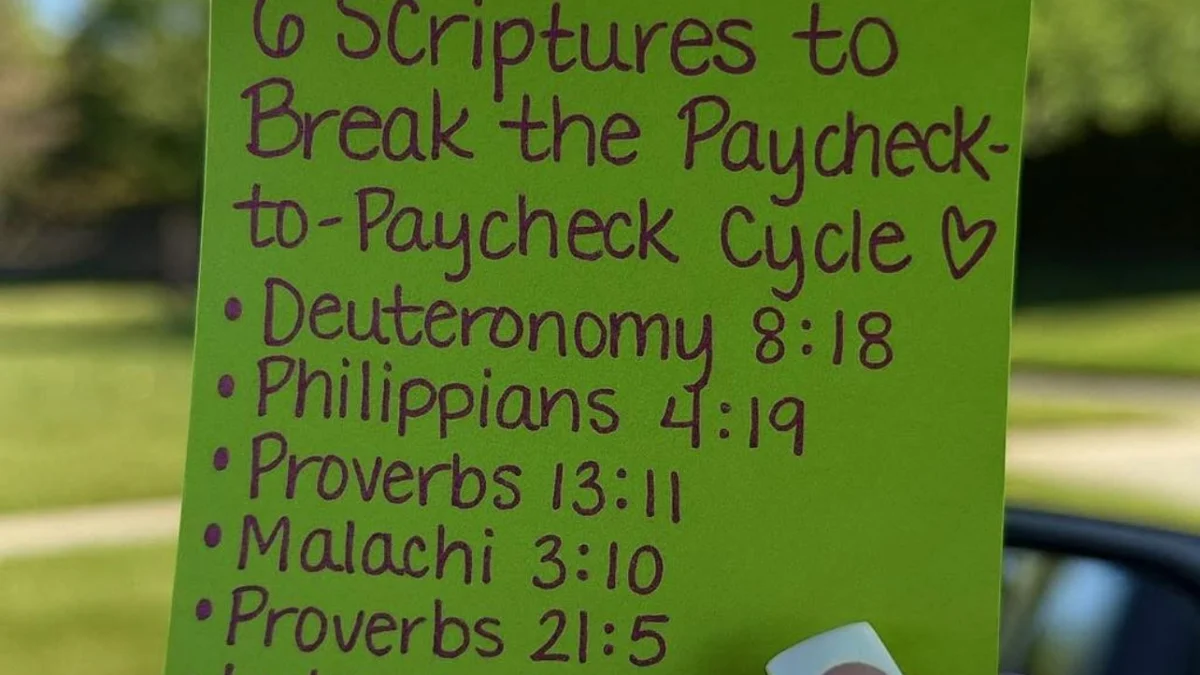
Staring at a dwindling bank account the night before payday can feel incredibly lonely. If you have ever gripped your phone, calculating how to stretch twenty dollars into a week’s worth of groceries, you know the weight of that anxiety. The green sticky note in the image captures a quiet moment of seeking answers, not from a financial advisor, but from ancient words. It lists six specific scriptures to break the paycheck cycle, offering a starting point for those who want to align their money habits with their faith. The handwritten list against the bright blue sky feels like a small, hopeful rebellion against constant financial stress.
Why a Spiritual Approach Matters for Financial Stress
Money troubles rarely stay in the wallet. They creep into our sleep, our relationships, and our sense of self-worth. When a person is cycling through the same exhausting routine of earning and immediately spending, the problem isn’t just a lack of cash; it’s often a deep-rooted scarcity mindset. Logic tells us to budget, but fear tells us to panic.
The verses scribbled on that note represent a different category of advice. They focus on transformation rather than mere transaction. Using scriptures to break the paycheck cycle works on the internal dialogue first. It reframes provision as something that involves partnership between your diligence and a divine source, rather than a solo scramble. This approach matters because spreadsheets alone cannot calm a racing heart. True peace often requires meditating on promises that stability is possible, even when the numbers look grim.
Unpacking the 6 Scriptures for Financial Renewal
The curated list visible on the bright green note offers a compact toolkit. Each reference serves a distinct purpose, ranging from remembering the origin of wealth to the power of consistency. Let’s walk through them one by one to understand why they matter when you are trying to stop the drain.
Deuteronomy 8:18 – The Source of Capacity
This passage reminds you that the ability to produce wealth comes from a covenant, not just a job. It shifts the focus from being a victim of a paycheck to a recipient of power. When you feel incompetent or stuck in a low-income rut, this verse acts as a reset button. It suggests that you have a grantor of strength backing your efforts, which is a powerful thought when you feel like quitting.
Philippians 4:19 – Supply Meets Need
Living paycheck to paycheck warps your view of supply. You believe there is never enough. This verse counters that immediate fear by stating that your needs will be met according to glorious riches. It’s a bold statement to read when your fridge is empty. Using this as a daily affirmation breaks the cycle of fear-based saving and spending, creating room for confident, clear-headed decisions instead of desperate ones.
Proverbs 13:11 – The Slow and Steady Gathering
Quick fixes are tempting. Get-rich-quick schemes prey on desperation. This proverb praises gathering money little by little, or by labor. It validates the unglamorous process of slow growth. In a world of instant gratification, honoring the dignity of small, consistent steps is revolutionary. It gives you permission to celebrate the $5 you saved rather than mourning the $500 you don’t have yet.
Malachi 3:10 – The Open Windows Principle
Bringing the whole tithe into the storehouse is often controversial, but read it as a test of trust. The imagery of opening the windows of heaven and pouring out so much blessing that there is not room enough to store it directly opposes the “not enough” narrative. To break the paycheck cycle, you have to break the closed-fist posture. This verse challenges the survival instinct to hoard, proposing a cycle of giving that triggers a cycle of abundance.
Proverbs 21:5 – The Blueprint of Diligence
Impulse is the enemy of a balanced budget. This scripture draws a stark line between diligent planning leading to profit and hasty shortcuts leading to poverty. The sticky note, held up against the backdrop of a quiet suburban street and trees, mirrors this perfectly—a small, deliberate plan standing firm in a big world. Diligence here isn’t just working hard; it’s the mental labor of mapping out where the money goes before payday even arrives.
Luke 16:10 – The Little Things Matter
You might be waiting for a massive raise to fix everything. This verse argues that faithfulness in microscopic amounts is the real training ground. If you can’t steward a $50 surplus wisely, a $5,000 windfall won’t save you. It places the full accountability back in your hands, not on your employer’s payroll scale. It’s a call to treat every dollar passing through your hands—even the ones spent on small daily coffee runs—with high integrity.
Moving From Reading to Practical Application
Reading the words on a sticky note is step one. Writing them on your heart is where the shift happens. The personal touch of a manicured hand holding that note suggests an active engagement, not a passive glance. Applying these scriptures to break the paycheck cycle requires a bridge between spiritual meditation and Monday morning reality.
Start by choosing one verse that feels most counterintuitive to your current fear. If you feel hopeless about your income, Deuteronomy 8:18 is your anchor. If hoarding every penny causes anxiety, meditate on Philippians 4:19. Write it down exactly like the person in the image did. The physical act of putting pen to sticky note and placing it somewhere you see daily—a bathroom mirror, a dashboard, or a debit card sleeve—interrupts the automatic spiral of worry.
Pair the scripture with a tiny physical action. If you are meditating on “gathering little by little,” physically transfer one dollar to a savings account you never touch. If focusing on “faithful with very little,” track your cash spending for just one day without judgment. The goal is to prove the verse true through experience.
Building a Resistant Mindset Against Financial Panic
The “paycheck-to-paycheck” label often locks people into identity-level discouragement. You aren’t just a person managing cash flow; you become “broke.” These six scriptures collectively dismantle that identity. They call you capable, supplied, diligent, and trustworthy.
The environment in the image—open sky, green trees, and space—subtly reinforces this. Financial panic feels like a closed, dark room. Meditating on these truths brings your mind out into the open air. It’s easier to think creatively about side hustles, negotiation, or resource sharing when you aren’t mentally suffocating. A resistant mindset assumes a solution exists, long before you see the deposit hit your bank. It reframes a budget not as a starvation diet, but as a blueprint for profit.
When a shortage hits, the knee-jerk reaction is often shame. However, a resistant mindset holds steady, reciting the truth that provision is a promise, and that diligent hands will rule. This emotional regulation is the difference between a temporary setback and a catastrophic spiral.
Useful Tips for Daily Encouragement
It’s normal to wake up with that familiar pit in your stomach on a Monday morning, even after reading these truths. Here are a few gentle ways to keep the spiritual pressure on the financial anxiety:
- Set a Phone Wallpaper: Screenshot a simple graphic of one of the verses. You check your bank balance on your phone; let the scripture be the first thing you see instead of the red numbers.
- The Breath Pause: Before you swipe your card at a store, physically take one deep breath and whisper, “Proverbs 21:5.” It’s an instant check against hasty purchases.
- The Envelope Promise: Label one envelope in your home “Philippians 4:19 Supply.” Even if it sits empty, it serves as a visual manifestation that a supply channel exists beyond your main job.
- Gratitude Audit: When resentment builds over bills, list three small things you spent money on that brought genuine value—faithfulness in little involves recognizing good stewardship, not just cutting costs.
Frequently Asked Questions About Faith and Finances
Navigating the intersection of spiritual belief and practical money management brings up tough, honest questions. These aren’t signs of weak faith; they are signs you are taking this seriously.
Does tithing make sense if I am struggling to buy necessities?
This is a deeply personal and challenging question. The principle of Malachi 3:10 isn’t about a transactional payment to get rich. It’s about challenging a spirit of fear. If 10% feels impossible right now, consider starting with an intentional act of giving, however small—perhaps your time or a literal few dollars. The principle is about keeping the flow of generosity open. Closing your hand completely because of fear often reinforces the very scarcity you are trying to escape. Give in a faith-stretching, not a foolish, way.
Is it wrong to want more money according to the Bible?
The desire for stability is not the same as the love of money. Scriptures to break the paycheck cycle, like Deuteronomy 8:18, clearly state the power to get wealth is given. Wanting to break the stress cycle so you can give more, sleep better, and serve with more energy is a wholesome desire. The problem comes when money becomes the primary anchor of your identity. Your goal is provision for vision, not accumulation for status.
How can I be “diligent” when I work hard but have nothing left?
Proverbs 21:5 addresses diligence not just in earning, but in planning. You might currently be working very hard physically but being hasty with the outflow. Diligence applies to administration as well as labor. Even ten minutes of scheduling automatic transfers or writing a meal plan is a form of diligent profit planning that separates your income from impulsive depletion. It means being a detailed manager, not just a hard worker.
What if I feel too guilty to pray about money?
Guilt often silences us, making us feel unworthy to ask for help. But the scriptures show that provision is part of a daily covenant, much like bread. You wouldn’t feel guilty asking for daily bread. Viewing the breaking of the paycheck cycle as a request for daily bread rather than lottery winnings removes the shame. Your middle-of-the-month stress is not a surprise to the provider mentioned in Philippians 4:19.
A Steady Path Forward
That little green note held against the infinite sky holds a quiet power. It represents a moment where worry met wisdom and chose to listen. Walking out of a financially stressed identity into a place of stability is rarely a dramatic lightning strike. It’s a slow, deliberate walk, guided by simple truths written on repeat. Let these six verses be the framework that holds you steady. Your paycheck doesn’t define the ceiling of your supply; it’s simply a tool. Treat it with diligence, release it with faith, and trust that the cycle can, and will, be broken.