
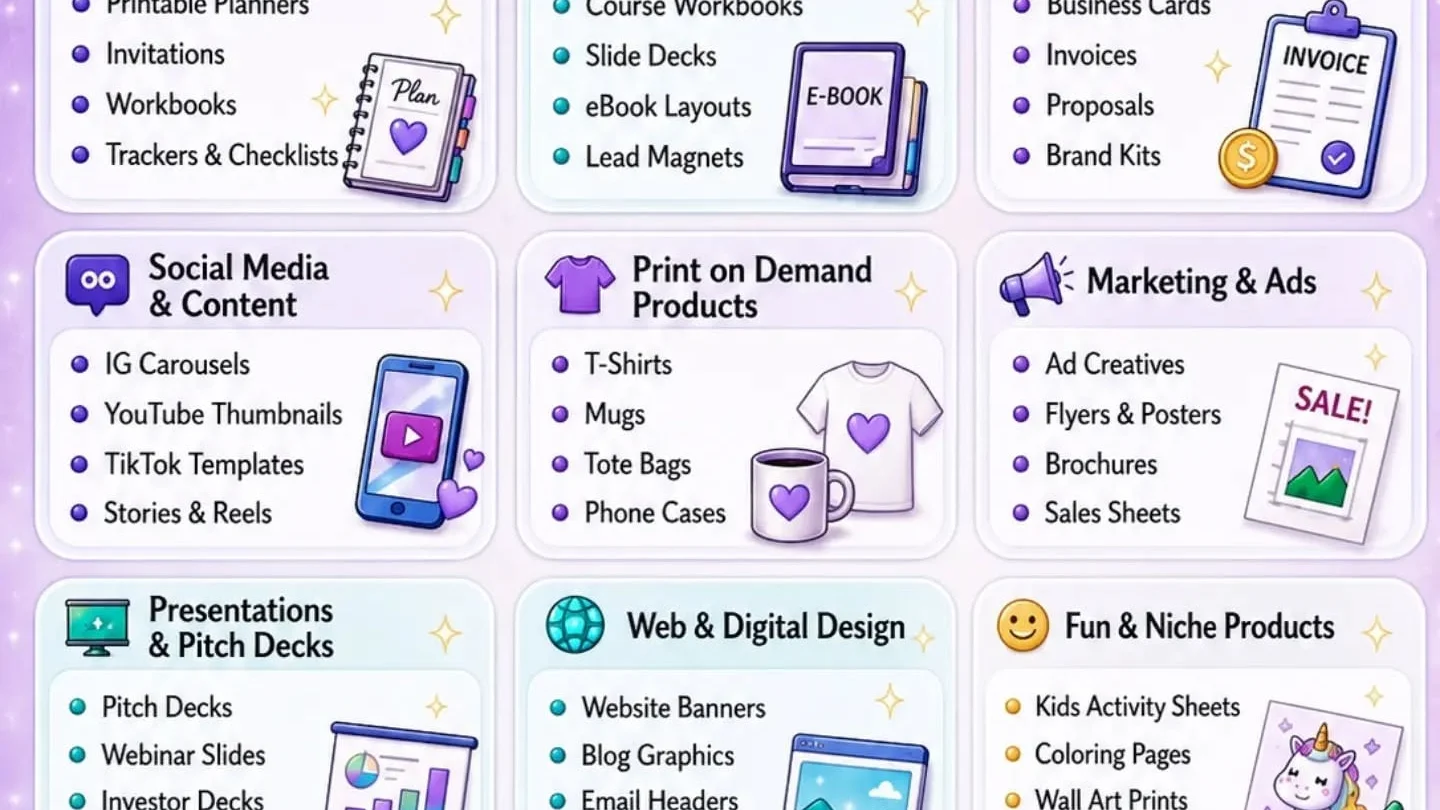
You can make money with Canva without being a trained designer. The tool handles the layout, the fonts, and the colour matching; you supply the taste and the follow-through. What separates people who earn from people who just post is simple: they sell something specific to a specific buyer, not “design services” to everyone.
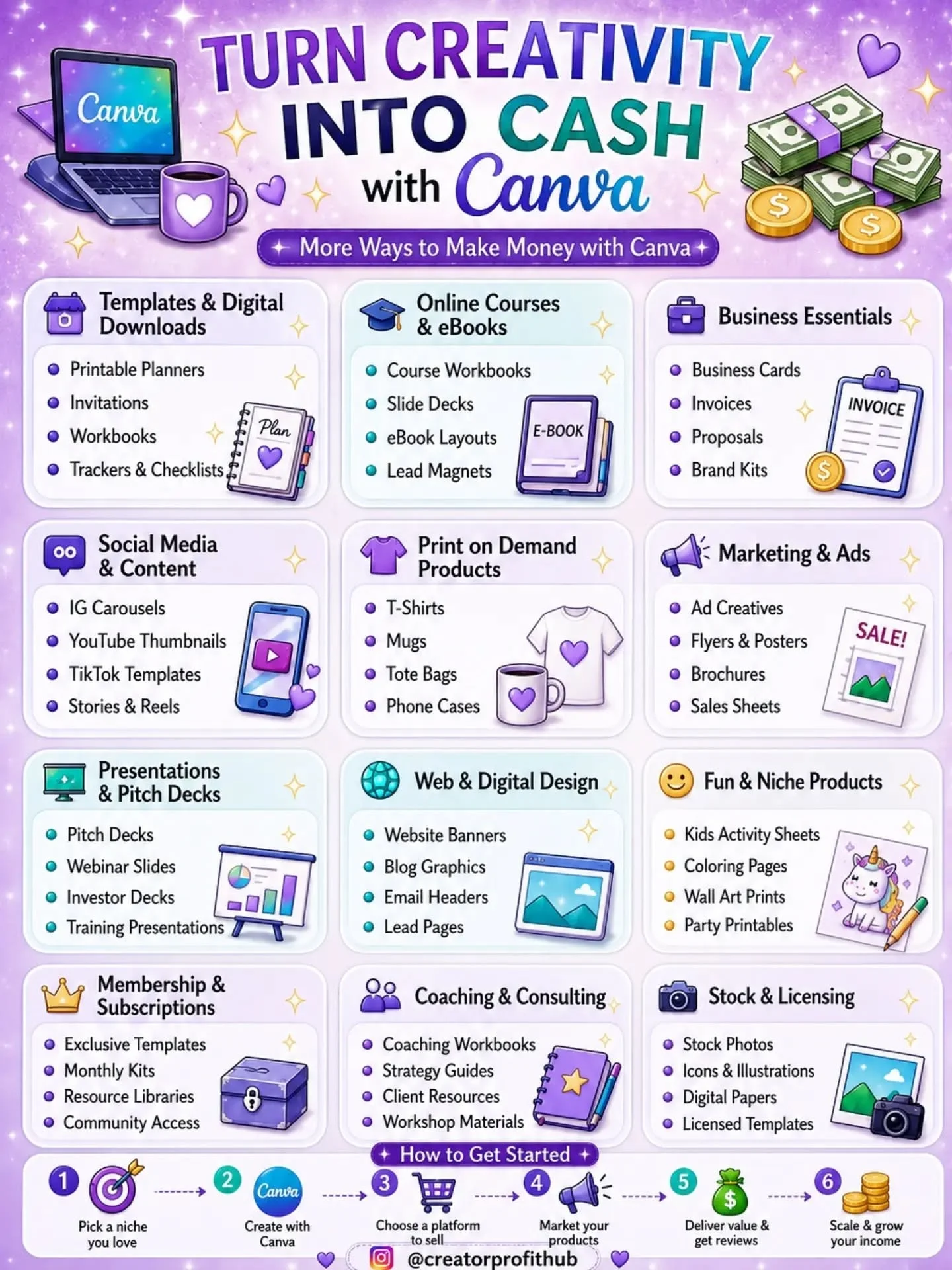
That infographic you saved — the purple one listing templates, courses, and print-on-demand — points at real income streams. Here’s what each one actually involves, what it costs you in time, and how to pick the lane that fits how you work.
What unites every Canva income idea
Every method below shares one mechanic: you build something once and sell it many times. That’s the whole game. A client project pays you once. A template you design at 9pm can sell while you sleep for the next two years.
The trade-off is upfront effort. You’ll spend hours on a product that might not sell for weeks. If you need money by Friday, do client work. If you can wait a month, build products.
Sell templates for a niche you know
Templates are the most direct Canva money-maker. You design a resume, an Instagram post set, a wedding invitation, a meal planner — then list it on a marketplace or your own site.
The mistake most people make is designing for “everyone.” A generic resume template competes with ten thousand others. A resume template for electricians seeking foreman roles competes with almost nobody. That specificity is what makes someone pay $12 instead of scrolling past.
Start with a niche you actually understand. If you’ve planned a wedding, you know what couples ask for. If you run a small bakery, you know what a bakery needs for its social posts. That insider knowledge is your edge.
Build a course that teaches one skill
Courses feel intimidating until you realise the bar is lower than you think. Nobody needs a 40-hour masterclass. A 45-minute video walking someone through “how to make a client proposal in Canva” sells fine at $19.
The key is teaching a task, not a topic. “Canva basics” is a topic; nobody buys that. “How to design a three-page menu for your food truck” is a task with a clear outcome. Record your screen, talk through your choices, and package the file as a PDF checklist.
You don’t need a fancy camera. Screen recording with clear audio beats a polished studio with mumbling. People want the steps, not your lighting setup.
Create business essentials for local companies
Small businesses need a shocking amount of design: invoices, receipts, business cards, social media kits, menu boards, flyers. Most can’t afford a design agency. They can afford $30 for a set of branded invoice templates.
This is where you bundle. A “new restaurant starter pack” might include a menu template, a social media post set, an opening day flyer, and a gift certificate. Price it at $49 and you’ve made more than selling each piece separately.
Walk into a few local shops and ask what they’re missing. You’ll hear the same answer repeatedly: “We just use the same post over and over.” That’s your product.
Go the print-on-demand route
Print-on-demand means you design artwork, upload it to a service, and they print it on t-shirts, mugs, posters, or tote bags when someone orders. You never touch inventory.
This works best when your design fits a specific audience. A mug that says “World’s Okayest Golfer” is a gamble. A poster of native bird illustrations for your state sells to a defined group who search for exactly that.
Read the platform’s rules before you start. Some have strict guidelines on file size, colour modes, and text placement. Getting rejected for a technicality wastes a week.
The margin per item is thin — often $3 to $8 — so this is a volume game. It suits you if you enjoy making many designs and don’t mind waiting for sales to accumulate.
Offer done-for-you design services
This is the oldest method and still the fastest cash. You offer to design social posts, presentations, or flyers for clients at a flat rate. $50 for a set of five Instagram posts is a common starting point.
Your Canva skill makes this fast. A template you’ve refined over time turns a two-hour job into a 30-minute one. That efficiency is your profit.
The downside is that you trade time for money. There’s no passive income here. But it’s the best way to build a portfolio and learn what clients actually request, which feeds every other method on this list.
Sell social media content packs
Content packs are templates bundled around a theme: “30 daily quotes for fitness coaches” or “12 weekly specials for coffee shops.” The buyer gets a month of posts ready to customise and schedule.
These sell because they solve a recurring problem. Business owners don’t lack design skills; they lack time to think of what to post. A pack that answers “what do I post on Tuesday?” is worth real money.
Price these between $15 and $40 depending on how many designs are inside. Keep the designs editable so the buyer can swap their logo and photos.
Design digital planners and printables
Planners, habit trackers, budget sheets, and meal planners are a steady market. People love buying organisation, even if they never use it.
These work well on Etsy-style marketplaces. The key is making them printable — check your margins and test-print one yourself before listing. A planner that cuts off the date column gets refunded.
Seasonal versions sell better than evergreen ones. A 2026 yearly planner has a sales window; a generic weekly meal planner sells year-round. Do both if you have the energy.
How to choose between these ideas
Ask yourself two questions. First: do you want money now or later? Client work pays now. Products pay later. Second: do you enjoy making many small things or one big thing? Print-on-demand suits the first; courses suit the second.
If you’re genuinely unsure, start with templates. They’re the shortest path from idea to sale, they teach you what buyers want, and they don’t require video or inventory. You can branch into courses or print-on-demand once you see which designs actually sell.
Adapting these ideas to your situation
On a tight budget? Every method here costs nothing but time. Canva’s free tier covers most template work; the paid tier is worth it once you’re earning, mainly for background removal and brand kits.
Short on time? Pick one product type and make three of them. Three focused products beat ten half-finished ones. A single well-made template that answers a specific need will outsell a scattered portfolio.
Not a designer? That’s fine. Canva does the heavy lifting. Your job is choosing good colours and clean layouts — and you can learn that by studying what sells in your niche. Look at the top five listings in any category and note what they share: colour palette, number of pages, style of mockup. Then make yours better.
Where to sell your work
You have three main options. Marketplaces like Etsy or Creative Market bring buyers but take a cut and charge listing fees. Your own website keeps all the profit but requires you to drive traffic. Social media can sell directly, but you’re at the mercy of the algorithm.
Most people start on a marketplace because the traffic already exists. The fee is worth it while you learn what sells. Once you have a repeat buyer base, move them to your own site with a simple checkout page.
If you’re also exploring other income angles, the same logic applies to selling physical products or services online. The principle stays constant: solve a specific problem for a specific person, and the money follows.
What actually matters for making sales
Three things decide whether you earn: your mockup, your description, and your niche. The mockup shows the product in use — a template displayed on a laptop screen sells better than a flat file. The description answers “what is this and who is it for?” in plain words. The niche determines whether anyone searches for it at all.
Skip the clever marketing. A clear title like “Editable Invoice Template for Cleaning Services” outperforms “Fresh Billing Solution.” Buyers search for what they need, not for poetry.
Start with one idea, make it well, and list it this week. The design won’t be perfect, but you’ll learn more from one real listing than from a month of planning. That’s the whole secret.