Starting a strength training habit can feel like stepping into a completely foreign world. The equipment looks unfamiliar, the terminology can be confusing, and it’s easy to wonder if you’re doing anything correctly at all. A straightforward beginner dumbbell workout for women at home strips away much of that uncertainty. It gives you a clear plan, a manageable set of movements, and permission to simply show up and do your best without comparing yourself to seasoned gym-goers.
What’s lovely about the printable routine shown here is its quiet simplicity. There are no complicated combinations or frantic pace demands. Just nine foundational exercises, a pair of dumbbells that feel right for your body, and instructions that keep things approachable. Whether you haven’t picked up weights before or are returning after a long break, this kind of plan meets you where you are.
What the Routine Appears to Be
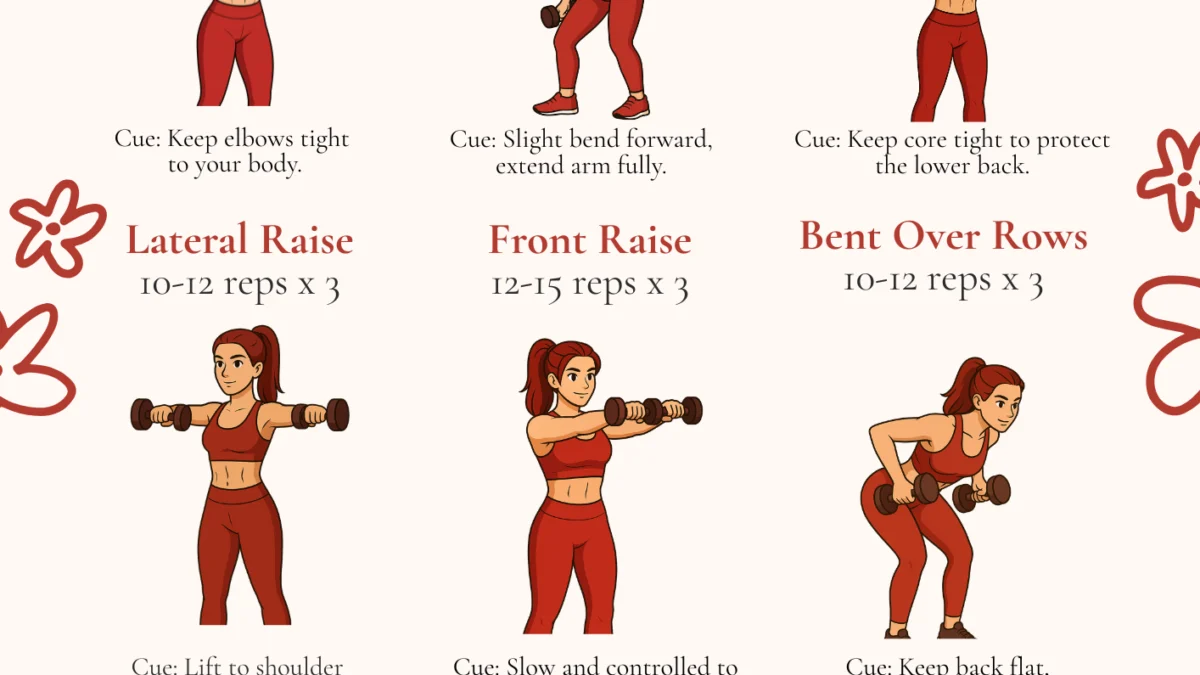
The image presents a one-page printable workout chart designed specifically for women who want a gentle, structured introduction to dumbbell training. At the top, a clear heading identifies it as a beginner-friendly workout plan. The layout is clean and uncluttered, with simple illustrations of a woman demonstrating each movement, paired with brief bullet points for rep counts and set recommendations.
The workout includes nine classic dumbbell exercises. Each one is displayed with a small graphic showing the exercise in motion, along with text indicating the suggested range of 12 to 15 repetitions per set. The plan also specifies performing three sets of each exercise, which offers enough volume to stimulate muscle adaptation without overwhelming a newcomer. The illustrations show a woman in a red sports bra and leggings, using various colored dumbbells including pink, black, blue, green, and yellow. The colors likely help differentiate weight options visually, though the focus stays firmly on form and consistency.
Useful Features Visible in the Image
Several thoughtful design choices make this printable workout chart stand out for someone just beginning their fitness journey. The first thing you may notice is the visual clarity. Each exercise has its own dedicated space, so your eye isn’t jumping around trying to figure out what comes next. The numbered sequence prevents that awkward pause mid-workout where you forget what you were supposed to do.
The rep range of 12 to 15 is particularly beginner-friendly. It’s high enough to build muscular endurance and help you learn movement patterns through repetition, yet low enough that you won’t feel completely drained halfway through your session. The three-set structure provides a reliable framework. You can start with just one or two sets during your first week if needed, then build toward the full three as your confidence grows.
The exercises themselves target all major muscle groups in a balanced way. You’ll find upper body work with bicep curls, hammer curls, and tricep kickbacks. Shoulder-focused movements include the overhead press, lateral raises, and front raises. Back engagement shows up through bent-over rows, while chest pressing motions and dumbbell squats bring in the front of the body and lower body respectively. This full-body approach means you aren’t neglecting any area, which matters for functional strength and posture in daily life.
Having the routine formatted as a printable also solves a real problem: decision fatigue. When your workout is already mapped out, you save the mental energy of piecing exercises together yourself. You can print the sheet, place it where you’ll see it, and simply follow along. That small act of preparation increases the likelihood you’ll actually complete the session.
Why This Approach Matters for Beginners
Strength training offers genuinely meaningful benefits for women at every stage of life, from supporting bone density and joint health to improving metabolism and daily functional capacity. The challenge for many beginners isn’t a lack of motivation, it’s often a lack of clarity. A structured beginner dumbbell workout for women at home removes the guesswork and makes the first step feel achievable instead of intimidating.
Starting with dumbbells rather than machines or barbells gives you freedom to move in ways that feel natural to your body. Dumbbells allow each arm to work independently, which helps identify and correct muscle imbalances gently over time. You can also adjust your range of motion easily if you have any joint stiffness or mobility limitations, something fixed machines simply don’t accommodate.
Home-based workouts offer another layer of comfort. You can wear what feels good, play your own music, pause whenever needed, and practice new movements without feeling self-conscious. For many women, that privacy makes the difference between starting and never trying at all. The calm, almost meditative quality suggested by the routine’s design reinforces that this is about self-care, not punishment.
Exercises Included in the Printable Routine
The nine movements visible on the chart represent a thoughtful selection of fundamental strength exercises. Here’s a quick walkthrough of what you’ll be doing, along with why each one matters:
- Bicep curls: A classic movement that strengthens the front of the upper arms. Useful for lifting groceries, carrying children, and everyday pulling motions.
- Tricep kickbacks: Target the back of the upper arms, an area many women want to tone. Also important for pushing movements like closing heavy doors.
- Shoulder press: Builds overhead strength, helping with tasks like placing items on high shelves or lifting luggage into overhead compartments.
- Lateral raises: Work the side shoulder muscles, improving shoulder stability and creating balanced upper body strength.
- Front raises: Engage the front shoulder area and complement the pressing movements for well-rounded shoulder development.
- Bent-over rows: One of the best exercises for posture. Strengthens the upper and middle back, counteracting the forward slump many of us develop from computer and phone use.
- Chest press: Often performed lying on the floor or a bench, this move strengthens the chest and front shoulders while also engaging the triceps.
- Hammer curls: A variation of the bicep curl with a neutral grip, which also works the forearm muscles and can feel gentler on the wrists for some people.
- Dumbbell squats: The lower body anchor of the workout. Squats strengthen the quadriceps, hamstrings, and glutes, supporting everything from walking and stair-climbing to getting up from a seated position.
Each exercise includes the instruction to complete 12 to 15 repetitions, repeated for three sets total. Beginners may find it helpful to rest 45 to 90 seconds between sets, long enough to catch your breath but not so long that your muscles cool down completely.
Who This Workout May Suit
This printable routine is clearly designed with a specific person in mind, and that person is likely someone who wants to begin without feeling overwhelmed. The workout suits women who are new to strength training, returning after a long hiatus, or simply looking for a gentler session on days when a high-intensity workout feels like too much. It also works well for anyone with limited equipment, since all you need is a pair of dumbbells and enough floor space to move safely.
The routine may appeal particularly to women who value structure and clarity. Having everything laid out on one page, with simple illustrations and straightforward rep counts, removes the barrier of not knowing where to start. It also suits those who prefer working out at home rather than in a gym environment, whether due to time constraints, childcare responsibilities, budget concerns, or personal comfort.
Older adults or those returning to exercise after pregnancy may find this routine appropriately measured, though it’s always wise to check with a healthcare provider before beginning any new physical activity program. The movements are foundational and generally accessible, but individual circumstances vary.
What to Consider Before Starting
Before printing the chart and grabbing your weights, a few practical considerations can help you set up for a positive experience. First, choose an appropriate dumbbell weight. As a general guideline, beginners often start with 2 to 5 pounds for shoulder exercises like lateral raises, and 5 to 10 pounds for larger muscle movements like squats and rows. The right weight is one where the last two or three repetitions feel challenging but still doable with good form.
Pay attention to your body’s signals throughout the workout. The goal is to feel muscle fatigue and maybe mild soreness the next day, not sharp pain during the movement. If an exercise causes discomfort in a joint rather than the muscle you’re intending to work, stop and check your positioning. Many local libraries and online platforms offer free video demonstrations of each basic movement if you want a visual reference beyond the printed illustrations.
Consider your environment too. You’ll need enough space to extend your arms fully to the sides and overhead, plus a clear area behind you for bent-over rows and kickbacks. A non-slip surface underfoot adds stability, especially during squats. Keep a water bottle nearby and wear supportive footwear unless you have experience training barefoot safely.
Rest days matter as much as workout days. If you’re new to strength training, aim to do this routine two to three times per week, with at least one rest day between sessions. This gives your muscles time to recover and adapt, which is where the actual strength-building process happens.
Care and Use Tips for Your Dumbbells and Printable
Taking care of your equipment helps maintain a consistent routine. If your dumbbells have a rubber or neoprene coating, wipe them down with a damp cloth and mild soap after each use, especially if you’ve been sweating. This keeps the grip surface clean and prevents any buildup of bacteria. For metal dumbbells, a similar gentle cleaning prevents rust and maintains the knurling on the handle that helps with grip.
Store your weights where they’re easy to access but out of walking paths to prevent tripping. A corner of a room, the bottom shelf of a bookcase, or a designated basket works well. The printable itself can be placed inside a clear sheet protector to keep it safe from water spills or sweat droplets. You might also tape it to a wall at eye level or clip it onto a music stand so you can reference it without looking down repeatedly during exercises.
Frequently Asked Questions
How heavy should my dumbbells be for this beginner workout?
There’s no single correct answer because it depends on your current strength level and the specific exercise. A good approach is to have two pairs available: a lighter set for shoulder movements like lateral raises and front raises, and a slightly heavier set for squats, rows, and curls. Beginners often find 3 to 5 pounds suitable for smaller muscle groups and 8 to 12 pounds for larger ones. The key indicator is being able to complete 12 to 15 repetitions with proper form while the last few reps feel noticeably challenging. If you can breeze through all 15 without effort, the weight is probably too light. If your form breaks down by rep six, it’s too heavy.
Can I do this workout every day?
Rest days are essential, particularly when your muscles are still adapting to new movement patterns. Strength training creates small tears in muscle fibers, and the repair process during rest is what actually makes you stronger. Doing the exact same workout daily doesn’t allow for that recovery. Two to three sessions per week, spaced with at least one rest day between them, is a sensible starting point. On the days in between, gentle walking, stretching, or yoga can complement your routine without interfering with recovery.
What if I can’t complete three sets at first?
Starting with one or two sets is perfectly acceptable and often wise. Your body needs time to learn the movements and develop the neuromuscular connections that make them efficient. Begin with one set of each exercise for the first week. Add a second set the following week if you’re feeling comfortable. Work toward the full three sets over the course of several weeks. Consistency wins over intensity every time for beginners. Completing fewer sets consistently beats doing the full workout once and then being too sore or discouraged to try again.
Is this workout enough to see results?
Many women find that a full-body routine done two to three times weekly produces noticeable improvements in strength, muscle tone, and daily energy levels within four to eight weeks. The visible results depend partly on factors like nutrition, sleep quality, stress levels, and overall daily activity. However, strength gains and the feeling of greater ease in everyday tasks often appear faster than visible changes. The most important result in the beginning is simply building the habit and learning to enjoy how movement makes you feel. Aesthetic changes tend to follow naturally when consistency is already in place.
Do I need any other equipment besides dumbbells?
The routine as shown requires only dumbbells and perhaps a mat for comfort during chest presses if you’re performing them on the floor. A sturdy chair or low bench can be helpful for seated shoulder presses, though standing works just as well. Water, supportive shoes, and comfortable clothing complete the list. The workout is intentionally minimal in its equipment needs, which is part of why it’s so practical for home use.
Making This Routine Your Own
Once you’ve spent a few weeks with this beginner dumbbell workout for women at home, you may naturally start wondering about progressions. The simplest way to continue challenging your muscles is to slowly increase the weight you’re using once 15 repetitions per set no longer feels demanding. Even adding one or two pounds makes a meaningful difference over time. You can also add a fourth set to each exercise, extend the workout with a brief walk afterward, or begin experimenting with slightly different rep ranges.
The printable chart serves as a foundation rather than a permanent limitation. Some days you might complete the full three sets with energy to spare. Other days, a single set feels like an achievement. Both experiences are valid, and both contribute to the larger picture of caring for your body over the long term. Giving yourself permission to adapt the plan to your energy, mood, and circumstances honors the gentle spirit this routine was designed to embody.
Building strength as a woman doesn’t require aggressive intensity, perfect technique from day one, or hours of gym time. It asks for a willingness to begin, a patient attitude toward your own learning process, and the simple act of returning to the routine again and again. Your body will respond in its own time, and that response often extends far beyond the physical, touching confidence, resilience, and how comfortably you inhabit your own skin.